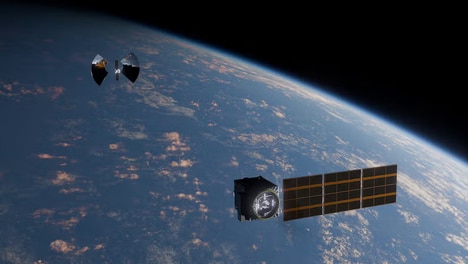

Loft Orbital demonstrated the first reported use of a vision-language model aboard an Earth observation satellite, enabling its YAM-9 spacecraft to identify targets directly in orbit from natural-language prompts. The system combined Google DeepMind’s Gemma 3 with NASA JPL’s NAVI-Orbital software, optimized to run on constrained hardware including an Nvidia Jetson Orin AGX processor.
The onboard AI successfully classified landscapes where natural and developed environments meet and identified infrastructure around railway hubs, reducing the need to transmit large volumes of raw imagery for ground-based analysis. Loft developed YAM-9 as a pathfinder for its infrastructure-as-a-service model, allowing third parties to deploy computing and sensing workloads in orbit, while the mission also provided insights into power and memory management for future space-based AI systems.
For researchers and commercial users, onboard AI promises faster, more actionable Earth observation with lower bandwidth demands, marking a significant step toward autonomous satellite constellations capable of continuous monitoring and intelligent, real-time analysis.
Image Credit: Loft Orbital
Why This Trend Is Growing
- Onboard Satellite AI
- Space-based vision-language processing creates new possibilities for real-time image interpretation without dependence on ground-based analysis pipelines.
- Natural-language Earth Observation
- Prompt-driven satellite intelligence enables nontechnical users to query orbital imagery in flexible ways, expanding access to geospatial insights.
- Autonomous Orbital Computing
- Edge computing in space reduces bandwidth constraints and supports continuous monitoring models that can transform satellite operations.
Industries Being Reshaped
- Aerospace
- Satellite platforms with embedded AI are reshaping spacecraft design around onboard decision-making, adaptive sensing, and distributed orbital infrastructure.
- Geospatial Analytics
- Faster extraction of infrastructure, environmental, and land-use intelligence from orbit introduces new commercial models for monitoring and risk assessment.
- Telecommunications
- Lower data transmission requirements from intelligent satellites create opportunities for more efficient network capacity, latency management, and space-to-ground connectivity.