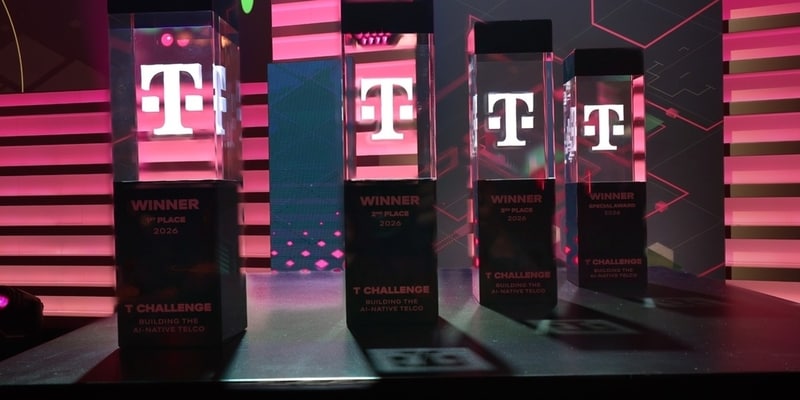
T-Mobile and Deutsche Telekom have announced the winners of the 2026 T Challenge. This global competition highlights startups building practical artificial intelligence solutions for the telecommunications industry.
At the 2026 T Challenge, Stanford University took first place, followed by Cubig from the Republic of Korea in second, Daisytuner from Germany in third, and a special award going to zTouch from the United States. This year's competition focused on accelerating the shift toward an AI-native telecom future, emphasizing scalable technologies that can be embedded directly into network operations and customer experiences.
Arash Ashouriha, SVP, Group Technology, Deutsche Telekom, commented: “Building an AI-native telco takes more than incremental progress—it requires bold innovation and co-creation across the ecosystem. T Challenge is a platform for advancing high-impact AI ideas, and this year’s winners showed practical solutions where it matters most — for our networks and customers.”
Image Credit: T-Mobile x Deutsche Telekom
Key Themes Behind This Trend
- AI-native Networks
- AI-native network orchestration that embeds real-time models into radio and core layers, enabling self-optimizing capacity, predictive maintenance, and dynamic SLA differentiation for operators.
- Co-creation Ecosystems
- Cross-operator and startup co-innovation platforms that combine carrier assets and specialist AI teams to produce commercially viable, integrable solutions at telecom scale.
- Scalable Edge AI
- Distributed inference and model lifecycle management at the network edge that supports low-latency customer experiences and localized data governance while reducing backhaul costs.
Where This Applies
- Telecommunications
- Carrier networks evolving into software-first services stacks where embedded AI becomes a core differentiator for reliability, personalized experiences, and new revenue models.
- Cloud Infrastructure
- Cloud providers offering specialized telco-grade ML runtimes, orchestration, and federated training capabilities to support high-throughput, low-latency telecom workloads.
- Startup Accelerator Programs
- Industry-aligned accelerators that pair early-stage AI vendors with operator testbeds and commercial pathways, shortening validation cycles and de-risking large-scale deployments.