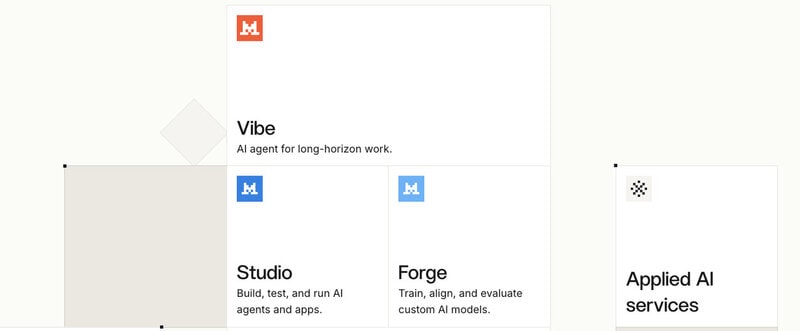
Adopting generative AI can be challenging when organisations need a balance between performance, flexibility, and deployment control. Mistral AI is a generative AI platform that provides both open-source and commercial language models for developers and businesses.
Its open models are designed for efficiency and are available under permissive licences, while its commercial models offer high-performance capabilities with flexible deployment options to suit different business needs. Designed for organisations building AI-powered applications, Mistral AI enables teams to integrate advanced language models while maintaining greater control over how and where they are deployed. By supporting both open technology and enterprise-grade solutions, the platform offers flexibility for a wide range of AI use cases. Mistral AI helps businesses and developers build, deploy, and scale AI applications with models designed for performance, portability, and openness.
Image Credit: Mistral AI
Why This Trend Is Growing
- Open-source AI
- Permissive language models are reshaping enterprise adoption by reducing vendor lock-in and enabling faster customization across specialized business use cases.
- Portable AI Deployment
- Flexible deployment across cloud, on-premise, and hybrid environments creates room for AI platforms that align with security, compliance, and infrastructure priorities.
- Enterprise Model Customization
- Business-focused generative AI is evolving toward adaptable models that balance high performance with domain-specific control and scalable application development.
Industries Being Reshaped
- Artificial Intelligence
- Open and commercial model ecosystems are expanding competitive possibilities for developers building enterprise-grade generative AI applications.
- Cloud Computing
- Portable AI infrastructure is increasing demand for cloud services that support flexible, secure, and performance-driven model deployment.
- Enterprise Software
- AI-enabled software platforms are shifting toward embedded language model capabilities that improve workflow automation, knowledge management, and decision support.