
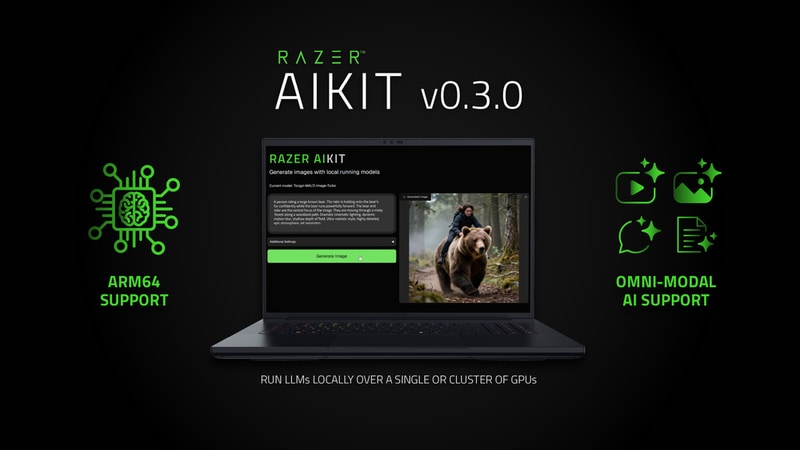
Local-first AI development platforms are changing how developers build and deploy generative AI applications by enabling image, video, and audio models to run directly on local hardware instead of relying entirely on cloud infrastructure. Razer AIKit expands this approach by supporting multimodal AI workflows across devices and architectures, allowing developers to prototype, test, and deploy AI experiences through a unified system. The platform also leverages decentralized GPU networks to reduce inference costs while maintaining scalable performance for high-volume deployments.
This model can significantly reduce operating expenses tied to cloud-based AI services while giving companies greater control over data, performance, and deployment environments. It also enables faster experimentation and more scalable AI integration across industries such as gaming, content creation, and edge computing. As local AI processing becomes more accessible, businesses may increasingly shift toward decentralized and hardware-efficient AI strategies.
Image Credit: Razer
What's Driving This Trend
- Local-first AI Development
- Organizations gain the ability to lower recurring cloud costs and retain sensitive data by moving model inference and training workflows onto customer-owned hardware.
- Multimodal On-device Inference
- Running image, video, and audio models directly on devices enables richer real-time user experiences without heavy reliance on network latency or bandwidth.
- Decentralized GPU Networks
- Pooling distributed GPU resources creates more cost-effective and scalable inference capacity that can undercut traditional centralized cloud providers for high-volume workloads.
Who This Affects Most
- Gaming
- Game developers and platform operators can deliver low-latency, personalized AI-driven gameplay and assets by embedding multimodal models on consoles and PCs.
- Content Creation
- Creative studios and independent creators can accelerate iterative multimedia production while maintaining intellectual property control through local AI tooling.
- Edge Computing
- Telecoms and industrial operators can support distributed AI services at the network edge to reduce central processing bottlenecks and improve service resilience.