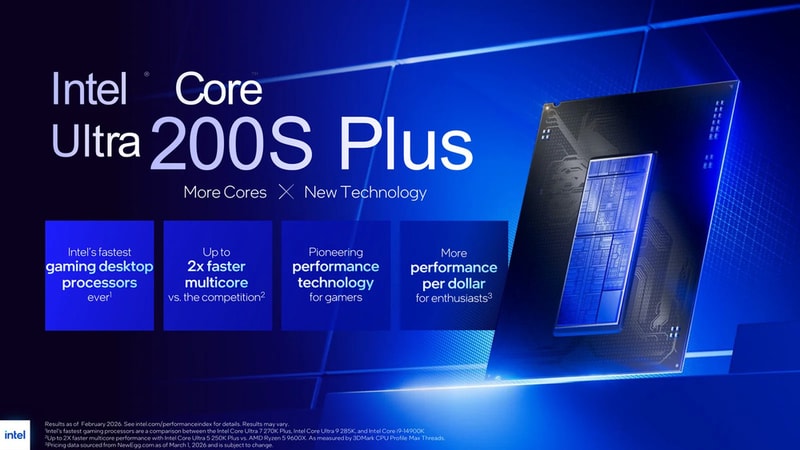
Intel introduced an Arrow Lake Refresh laptop CPU family, launching the Core Ultra 7 270K Plus and Core Ultra 5 250K Plus, featuring higher core counts and faster memory to boost gaming and multitasking. The chips were presented as performance-focused mobile processors designed to deliver improved frame rates and responsiveness in thin-and-light notebooks.
The refresh increases CPU cores and memory bandwidth while maintaining competitive pricing, with Intel positioning the models as value-driven options for gamers and creators. Manufacturers will adopt the new SKUs across mainstream laptop lineups, pairing them with updated graphics and cooling to maximize sustained performance.
For consumers, the arrival of these refreshed Core Ultra parts promises better on-the-go gaming and content work without forcing premium upgrades, reflecting a broader trend of accessible high-performance components in mainstream laptops.
Image Credit: Intel
Why This Trend Is Growing
- Accessible High-performance Mobile Cpus
- Widespread availability of higher-core, faster-memory laptop processors is enabling premium-class performance in mainstream thin-and-light designs, creating scope for new product tiers that blur the line between ultraportable and desktop-replacement machines.
- Memory Bandwidth Scaling
- Rising memory bandwidth paired with increased core counts is shifting performance bottlenecks away from raw CPU cycles toward memory and I/O subsystems, opening potential for novel memory architectures and cache-coherent accelerators.
- System-level Performance Optimization
- Improved processors being matched with updated graphics and cooling highlights an ecosystem trend toward co-designed hardware and thermal solutions, fostering integrated platform innovations that sustain peak performance in compact form factors.
Industries Being Reshaped
- Laptop Manufacturers
- OEMs stand to redefine mainstream portfolios by integrating higher-performance SKUs into value lines, enabling new design trade-offs between portability, battery life, and sustained gaming or creative workloads.
- Game Development and Esports
- Developers and competitive gaming ecosystems may leverage more capable mobile hardware to create richer real-time experiences optimized for higher frame rates and heterogeneous CPU/GPU workloads on laptops.
- Cooling and Thermal Solutions
- Advances in sustained mobile performance increase demand for compact, efficient thermal management approaches, encouraging innovation in materials, vapor chambers, and active cooling architectures for thin notebooks.