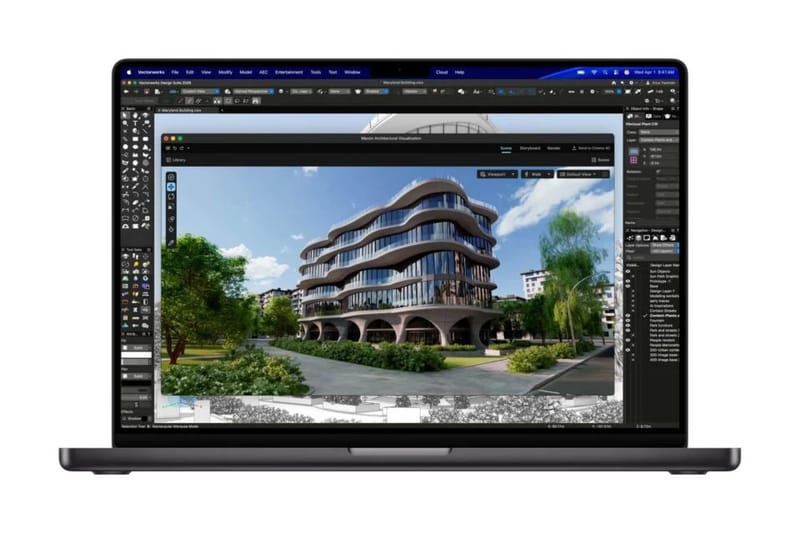
Apple introduced the M5 Pro and M5 Max system-on-chip designs for its latest 14- and 16-inch MacBook Pro models, featuring a Fusion architecture that combines two separate 3nm dies with a low-latency bridge. The setup separates GPU silicon from CPU elements, enabling larger graphics arrays without bloating a single die. The chips debuted as part of Apple’s new MacBook Pro lineup and accompany updated Liquid Retina XDR displays and base storage configurations.
The M5 Pro scales to an 18-core CPU and up to a 20-core GPU, while the M5 Max supports an 18-core CPU and up to a 40-core GPU, with Apple offering multiple core and memory configurations across price tiers. Apple also retooled core roles—introducing “super” cores alongside upgraded performance cores—and kept unified memory baselines that affect pricing and performance choices.
For users, the modular die approach means more configurable graphics and multithreaded power for creative and professional workflows, while trade-offs include higher entry prices and questions about thermals and battery endurance. The design reflects a broader trend toward chiplet-style scaling that prioritizes configurable performance in premium laptops.
Image Credit: Apple
Key Themes Behind This Trend
- Modular Chiplet Architectures
- Separation of GPU and CPU dies enables scalable graphics arrays and configurable performance envelopes for premium laptops.
- Unified Memory Baselines
- Apple's fixed unified memory tiers create a direct coupling between configuration choices, price stratification, and workload performance outcomes.
- Tiered Core Roles
- The introduction of 'super' cores alongside upgraded performance cores reflects a move toward heterogeneous core specialization tailored to varied multithreaded and single‑threaded tasks.
Where This Applies
- Laptop Manufacturing
- Thermal and battery trade-offs from denser GPU arrays drive demand for novel cooling architectures and power-management hardware designs.
- Professional Creative Software
- Variable GPU and memory configurations create opportunities for software that adapts rendering pipelines and resource utilization to heterogeneous client hardware.
- Cloud and Edge Computing
- Chiplet-style scaling influencing client devices is likely to shift compute distribution strategies, enabling differentiated acceleration between edge endpoints and centralized clouds.