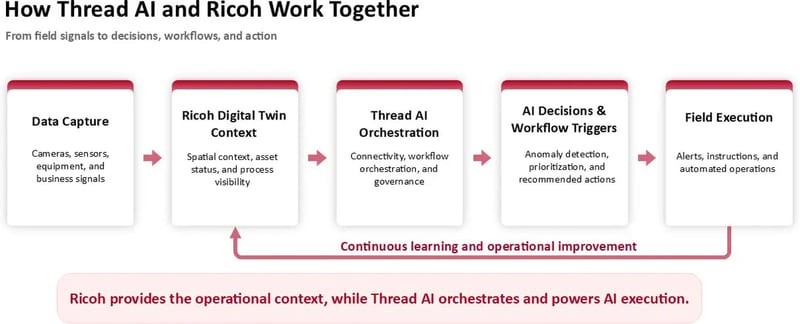
Ricoh and Thread AI are collaborating on an AI-powered execution platform that combines digital twins, multimodal AI, and workflow orchestration to automate facility management tasks. Rather than limiting AI to monitoring or analysis, the platform connects sensor, camera, and operational data to support real-time decision-making and execute maintenance workflows with greater speed and accuracy. The system will first be piloted across Ricoh's facilities in Japan to validate end-to-end automation before expanding into broader digital services.
For enterprises, this approach signals a shift toward autonomous operational management, where AI coordinates inspections, maintenance, and resource allocation with minimal manual intervention. By reducing dependence on individual expertise and standardizing complex processes, organizations can improve efficiency, lower operational costs, and scale consistent facility management practices across multiple locations. This model also creates new opportunities for AI-enabled infrastructure services that combine physical and digital operations.
Image Credit: Ricoh
What's Driving This Trend
- Autonomous Facility Management
- AI-coordinated inspections, maintenance, and resource allocation are reshaping facilities into self-managing environments with lower reliance on manual oversight.
- Digital-twin Workflow Automation
- Real-time virtual replicas of buildings and assets create new value by linking operational data directly to automated task execution.
- Multimodal Operations Intelligence
- Sensor, camera, and enterprise data fusion enables more accurate facility decisions across distributed locations and complex service networks.
Who This Affects Most
- Facility Management
- Building operations providers are positioned to evolve from reactive service models into AI-enabled platforms that standardize maintenance across large property portfolios.
- Enterprise Software
- Workflow orchestration vendors gain relevance as physical infrastructure becomes integrated with digital systems for automated decision-making and execution.
- Smart Infrastructure
- Connected buildings and industrial sites are becoming service-ready environments where digital twins and AI systems support scalable operational automation.