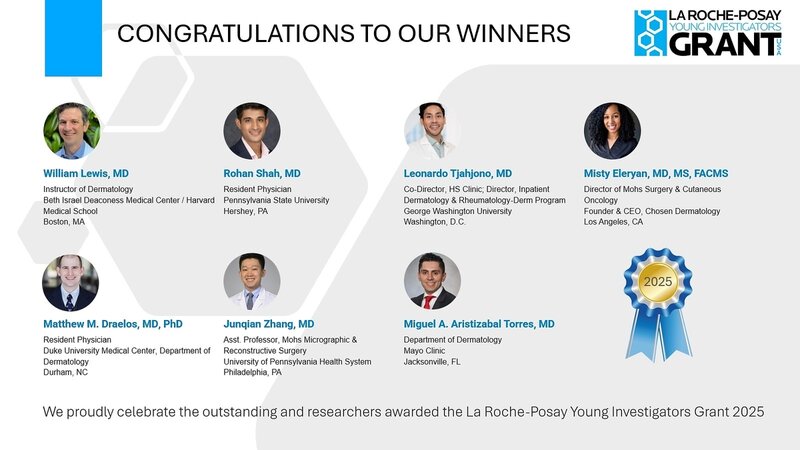
La Roche-Posay, a dermatologist-recommended skincare brand, has announced the recipients of its 2025 Young Investigator Grant program while simultaneously opening applications for the 2026 cycle. This initiative strives to provide financial support to early-career dermatologists, residents, and fellows conducting clinical research aimed at improving patient outcomes in areas such as clinical medicine, biology, and pharmacology.
The Young Investigator Grant program distributed $50,000 in total grants across eight diverse projects, covering topics that range from developing a translucent suture pad for surgical training and studying combined biologic therapy with deroofing surgery for hidradenitis suppurativa, to creating topical chemical probes for fluorescence-based skin cancer detection, designing a transplant-specific quality-of-life module for organ recipients with keratinocyte carcinoma, evaluating hybrid teledermatology and mobile care models for rural communities, using laser therapy and skin barrier science to help survivors of human trafficking, and exploring fractional cryotherapy for skin resurfacing and pigmentary modulation.
Image Credit: La Roche-Posay
What's Driving This Trend
- Early-career Research Funding
- Brand-backed grant models are expanding access to clinical innovation by helping emerging specialists test high-impact ideas before traditional funding pathways are available.
- Hybrid Dermatology Access
- Teledermatology paired with mobile care reflects a growing shift toward decentralized specialty treatment for rural, underserved, and hard-to-reach patient populations.
- Diagnostic Skin Technologies
- Fluorescence-based probes, translucent training tools, and novel imaging concepts signal new potential for faster detection, improved education, and more precise dermatologic care.
Who This Affects Most
- Dermatology
- Clinical research support is accelerating experimentation across skin cancer detection, inflammatory disease treatment, surgical training, and patient quality-of-life measurement.
- Medical Education
- Simulation tools and early-career investigator programs are reshaping how clinicians build procedural confidence and translate research concepts into practice.
- Digital Health
- Hybrid care models and mobile dermatology services highlight opportunities for platforms that connect specialty expertise with patients outside conventional clinic settings.