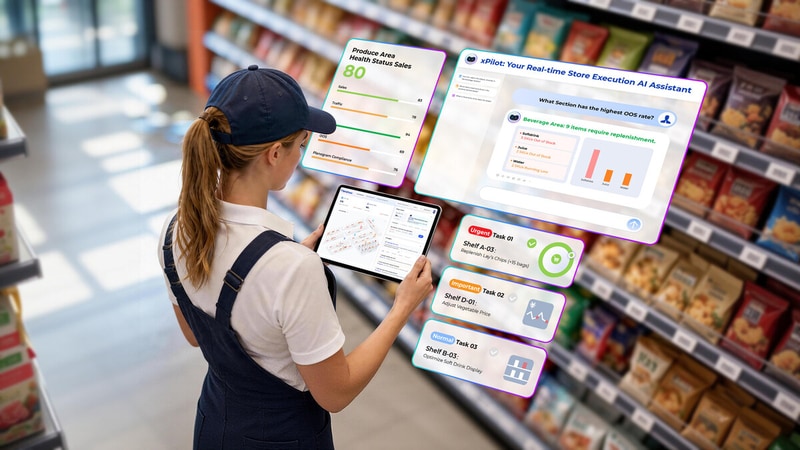
At NRF 2026 APAC, digital store solutions leader Hanshow announced the launch of xPilot, a store execution AI Assistant powered by digital twin technology.
Built on Microsoft Azure, xPilot uses Microsoft Fabric and combines real-time store sensing with AI-driven decision making and automated workflows so that retail teams are aware of on-shelf availability, planogram compliance and operational alerts. What's more, with xPilot, retailers benefit from live heatmaps covering sales, traffic, conversion, labor and energy usage. "Retailers don't need more tools in the store—they need more intelligence. A real-time store digital twin, paired with unified data and AI agents, helps teams move from seeing what's happening to acting on it in the moment—raising Store IQ and accelerating the journey toward a Frontier Store," said Christian O'Donohue, Sr. Industry Advisor, Retail and Consumer Goods, Microsoft.
What's Driving This Trend
- Real-time Store Twins
- Live digital replicas of store environments create new value in predictive execution, where inventory, traffic, labor and energy signals become continuously modeled operating intelligence.
- Agentic Retail Operations
- AI assistants embedded in store workflows represent a shift toward autonomous issue detection, task prioritization and coordinated execution across frontline teams.
- Sensor-driven Merchandising
- Connected shelf, camera and traffic data enables more adaptive merchandising systems that reveal planogram gaps, conversion patterns and localized demand changes in near real time.
Who This Affects Most
- Retail Technology
- Platform providers are positioned around unified store intelligence layers that combine IoT sensing, digital twins, workflow automation and enterprise AI.
- Grocery Retail
- High-frequency replenishment environments benefit from disruption around on-shelf availability, spoilage reduction, staff allocation and localized promotional performance.
- Workforce Management
- Labor optimization software is evolving as real-time operational alerts and store heatmaps reshape scheduling, task assignment and productivity measurement.