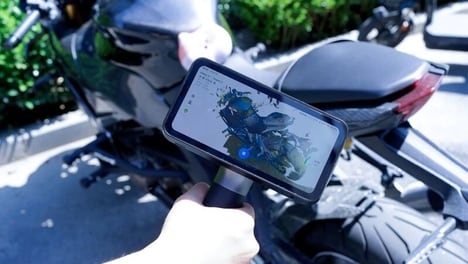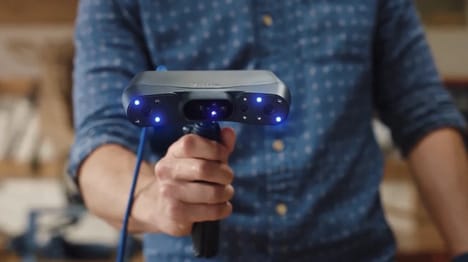
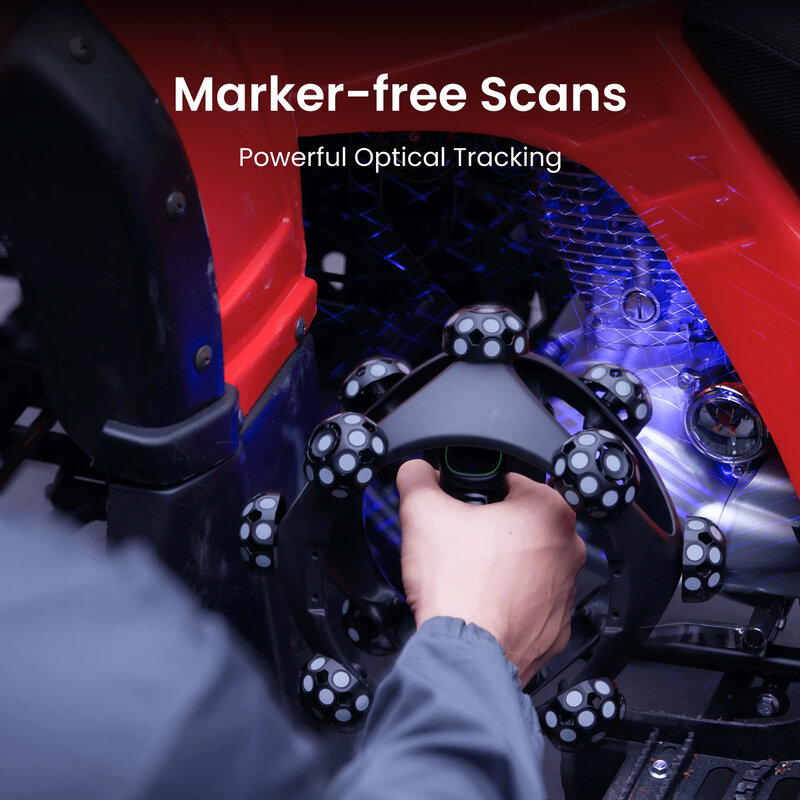
Revopoint introduced the Trackit SR, a marker-free wireless optical tracking 3D scanner designed for industrial metrology, reverse engineering and quality control. The system pairs a handheld scanner with a separate Tracker that monitors its position in real time, eliminating the need to place reflective markers across the scanned surface.
Trackit SR delivers single-frame accuracy of up to 0.02 mm and volumetric accuracy of 0.025 mm + 0.04 mm x L. It offers 30 cross-line, 17 parallel-line and single-line laser modes for scanning dark, reflective and metallic surfaces, while Wi-Fi 6 connectivity and up to 2.5 hours of battery life support mobile use. Captured data can move into Revo Measure for inspection or Revo Design for scan-to-CAD workflows.
For manufacturers and inspection teams, Trackit SR reduces setup time and cable restrictions while supporting measurements in labs, factories and field environments. The system reflects growing demand for portable, high-accuracy inspection tools that streamline digital manufacturing workflows.
Image Credit: Revopoint
Why This Trend Is Growing
- Marker-free Metrology
- High-accuracy scanning systems that remove surface preparation requirements create openings for faster quality control across complex parts and production environments.
- Wireless Inspection Workflows
- Cable-free measurement tools with real-time tracking expand the potential for flexible inspection in factories, labs and field-service settings.
- Scan-to-cad Automation
- Integrated capture, inspection and design software supports more seamless reverse engineering and digital manufacturing processes for industrial teams.
Industries Being Reshaped
- Industrial Metrology
- Portable optical tracking platforms are reshaping precision measurement by combining lab-grade accuracy with production-floor mobility.
- Advanced Manufacturing
- Manufacturers benefit from inspection technologies that shorten setup cycles and connect physical components more directly to digital workflows.
- Reverse Engineering
- Detailed 3D capture of reflective, metallic and dark surfaces strengthens opportunities for faster component replication, redesign and validation.