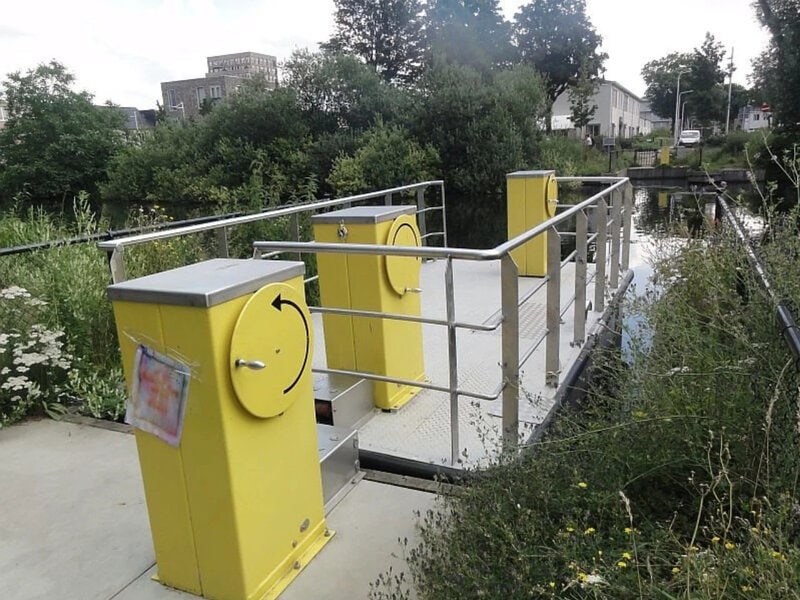
Tilburg floating ferry is a self-powered river crossing that carries cyclists and pedestrians across the Piushaven river using a manually operated platform. The floating deck is connected to a submerged chain spanning both banks, allowing users to propel the platform by turning a crank. Cranks are installed on each side of the river so the platform can be retrieved before boarding if it is docked on the opposite bank. The system operates without motors, fuel, or scheduled service, relying entirely on user input and a mechanical chain-driven mechanism.
The crossing was developed by the City of Tilburg as an alternative to a permanent bridge or staffed ferry service. Its compact infrastructure requires only the floating platform, submerged chain, and shore-mounted crank systems, reducing construction and operating complexity. The design supports continuous access throughout the day while requiring minimal maintenance compared with conventional ferry operations. The platform accommodates bicycles directly, allowing riders to continue their route without lengthy detours to fixed bridges.
Image Credit: Tilburg City
What's Driving This Trend
- Human-powered Mobility
- Manual propulsion systems present low-cost alternatives to motorized infrastructure in short-distance urban crossings and last-mile travel networks.
- Minimalist Civic Infrastructure
- Compact public works designs reduce construction complexity while expanding access in locations where bridges, vehicles, or staffed services are inefficient.
- On-demand Micro-crossings
- Self-service ferry platforms create flexible transit nodes that support pedestrians and cyclists without dependence on schedules or operators.
Who This Affects Most
- Urban Planning
- Municipal transportation networks can integrate small-scale mechanical crossings to improve route continuity in waterfront and canal-based districts.
- Cycling Infrastructure
- Bike-friendly ferry systems extend active mobility corridors by removing detours and preserving seamless movement across water barriers.
- Public Transportation
- Non-motorized shared transit assets introduce operational models with minimal staffing, fuel use, and maintenance requirements for localized mobility needs.