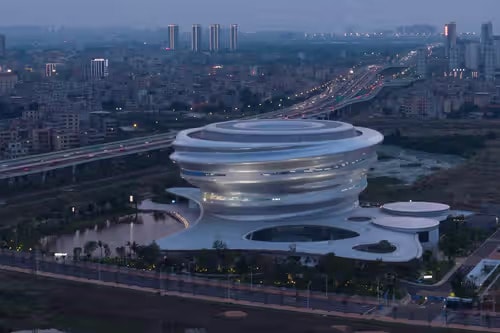
Ma Yansong and MAD have completed the Hainan Science Museum in Haikou, China, beside Wuyuan River National Wetland Park. The 46,528-square-metre building is organized around a continuous spiraling route that connects all galleries through a single circulation system. Visitors move through exhibition areas focused on space, oceans, rainforests, tropical agriculture, and children’s learning zones across multiple levels within the museum.
The structure is supported by three concrete core tubes, allowing the exhibition floors to remain column-free while elevating the ring-shaped volume above the surrounding plaza and reflecting pools. The exterior is clad in 843 fibre-reinforced polymer panels forming a reflective silver shell that changes appearance depending on daylight and weather conditions. Additional spaces within the museum include a planetarium, giant-screen cinema, sunken plaza, and outdoor educational areas connected by covered walkways.
Image Credit: MAD, designboom
What's Driving This Trend
- Biomimetic Reflective Facades
- A dynamic shell that shifts appearance with light and weather offers potential for adaptive building envelopes that modulate thermal performance and visual engagement.
- Column-free Modular Interiors
- The use of core-supported, columnless spans suggests new possibilities for flexible, reconfigurable large-span interior systems suited to changing programmatic needs.
- Immersive Spiral Circulation Exhibits
- A continuous spiraling route that links diverse galleries creates opportunities for narrative-driven spatial design that blends wayfinding, storytelling, and staged educational experiences.
Who This Affects Most
- Museum and Cultural Institutions
- Contemporary museum typologies focused on multisensory, sequenced journeys point toward evolving visitor engagement models and revenue-generating experiential offerings.
- Architectural Materials Manufacturing
- Specialized fiber-reinforced polymer cladding systems highlight demand for lightweight, high-performance façade components with customizable aesthetic and environmental properties.
- Educational Technology for Museums
- Integration of planetariums, giant-screen cinemas, and outdoor learning zones indicates rising scope for immersive digital content platforms that synchronize with physical exhibit narratives.