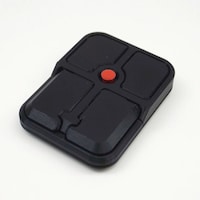
The Fitbit Air removes the traditional smartwatch display in favor of a compact screenless fitness tracker focused on passive health monitoring. The device features a slim curved band with embedded sensors that collect movement, sleep, heart rate, and activity data without requiring visual interaction on the wrist. Its smooth exterior eliminates buttons and displays entirely, creating a lightweight form designed to reduce distractions during daily wear. The minimalist structure is intended to feel closer to a simple accessory than a conventional smartwatch.
The concept shifts notifications and detailed metrics away from the wearable itself and into connected mobile devices. Its streamlined body uses a continuous matte finish with concealed internal hardware and a narrow profile designed for long-term comfort. The design explores how wearable health devices could prioritize passive tracking and reduced screen dependence while maintaining continuous biometric monitoring capabilities.
Image Credit: Google
Key Themes Behind This Trend
- Screenless Wearables
- A move away from on-device displays toward minimal bands creates opportunities for devices that prioritize form factor, battery longevity, and seamless aesthetics over interactive screens.
- Passive Biometric Monitoring
- Continuous, nonintrusive collection of heart rate, sleep, and movement data enables new models of health insights based on long-duration patterns rather than episodic readings.
- Distraction-free Design
- Eliminating buttons and visual interfaces promotes wearables that integrate into daily life as subtle accessories, shifting value toward comfort and social acceptability.
Where This Applies
- Consumer Wearables
- Simplified, screenless devices can redefine product segmentation by offering lower-cost, longer-life wearables aimed at users who prefer unobtrusive health tracking.
- Mobile Health Apps
- With detailed metrics delegated to smartphones, apps that synthesize passive streams into actionable trends could replace real-time device interaction as the primary user touchpoint.
- Textile and Smart Accessories
- Embedding sensors into minimalist bands and fabrics opens possibilities for fashion-forward health products that blur the line between jewelry and medical monitoring.