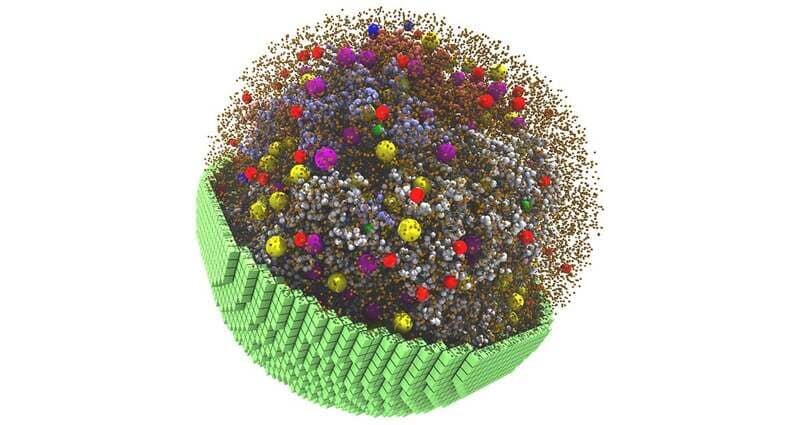
Scientists at the University of Illinois at Urbana-Champaign have successfully simulated living cells through the use of NVIDIA's GPUs. The cell simulated was a living minimal cell, which means the cell only has the minimal required genes to survive, function, and replicate. Despite this, a minimal cell still requires over two billion atoms.
With the use of NVIDIA GPUs processing over 7,000 genetic information simulations over the course of 20 minutes, a real-time 3D model of a living minimal cell was created. Scientists from the University of Illinois at Urbana-Champaign have stated that this is the most advanced and complex cell simulation to date. The software used for this simulation is called 'Lattice Microbes' which was co-developed by one of these scientists, Luthey-Schulten. Lattice Microbes is available for use from the NVIDIA NGC software hub.
Image Credit: NVIDIA, The University of Illinois at Urbana-Champaign
What's Driving This Trend
- Gpu-powered Cell Simulation
- The use of NVIDIA GPUs to simulate living cells presents a disruptive innovation opportunity for biotechnology companies interested in enhancing drug discovery and precision medicine.
- Real-time 3D Modeling
- Real-time 3D modeling of living minimal cells presents a disruptive innovation opportunity for researchers in the field of synthetic biology interested in creating new organisms with specific functions.
- Minimal Cell Simulation
- Simulating living minimal cells presents a disruptive innovation opportunity for the development of artificial life and the study of the fundamental processes of life.
Who This Affects Most
- Biotechnology
- The use of GPU-powered cell simulation has potential applications in enhancing drug discovery and precision medicine within the biotechnology industry.
- Synthetic Biology
- Real-time 3D modeling of living minimal cells has potential applications in creating new organisms with specific functions within the synthetic biology industry.
- Artificial Life
- Simulating living minimal cells has potential applications in the development of artificial life and the study of the fundamental processes of life within the artificial life industry.