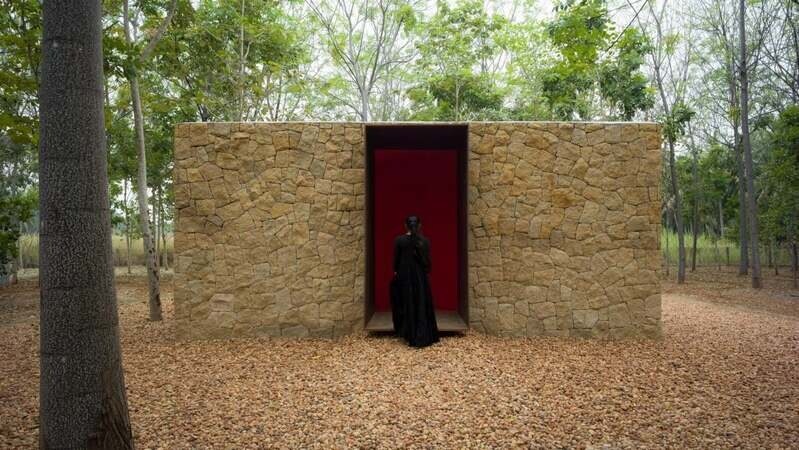
Commissioned by a son in memory of his father, Sanctum of Trees by 182 DESIGN is a profound architectural tribute rooted in reverence for nature. Located on a farmland transformed into forest, the design frames a stone monolith within a grove of trees the late patriarch planted, honoring his lasting legacy of generosity and ecological love.
The memorial unfolds as a structured procession inspired by Tamil temple sequencing: a raw metal portal leads into a compressed, red-stained concrete tunnel that opens into a circular chamber. This inner sanctum—an abstracted Karuvarai—houses an Adansonia digitata (baobab) tree, symbolizing resilience, time, and spiritual presence. The material contrast—the heart-like warmth of the concrete and the stone’s tactile, skin-like facade—reflects life and memory, forging narrative between humanity and nature. Over time, as the baobab grows and embraces the structure, the memorial becomes not just a monument, but a living legacy: rooted, evolving, and timeless.
Image Credit: LokeshPB
Key Themes Behind This Trend
- Nature-integrated Memorials
- Combining ecological elements with memorial architecture offers a dynamic approach to honoring legacies through living, evolving structures.
- Cultural Ritual Reinterpretation
- Reimaginings of traditional rituals in modern architecture create a bridge between contemporary design and cultural heritage.
- Materiality and Memory Fusion
- The use of contrasting materials to symbolize life and memories offers a profound narrative enhancement in architectural design.
Where This Applies
- Sustainable Architecture
- Incorporating ecological principles within architectural projects encourages enduring and environmentally harmonious designs.
- Cultural Heritage Preservation
- Promoting innovative architectural expressions of cultural rituals aids in the preservation and evolution of unique heritage practices.
- Material Science and Design
- Advanced exploration of material properties can redefine architectural storytelling and interaction with structures.