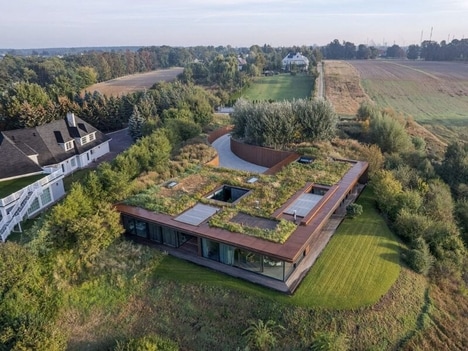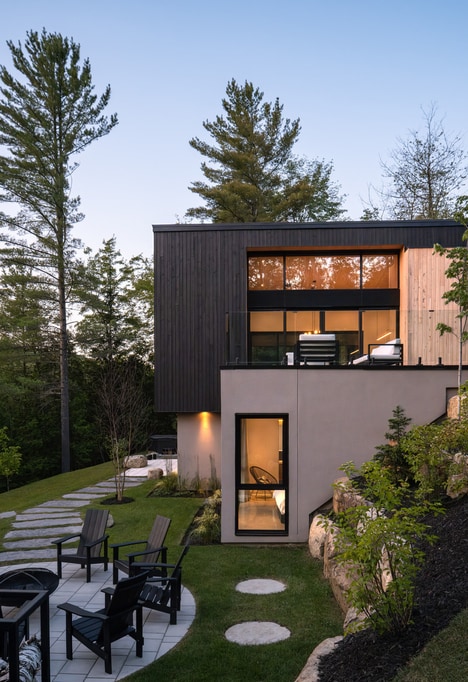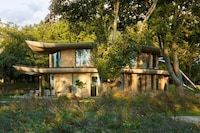
Superkül designed Ridge House in Grey County, Ontario, as a rural residence that subordinates its own architectural expression to the topography and ecological rhythms of its site. The 3,175-square-foot home is carefully embedded into a gentle declivity between open field and forest edge, reportedly, without disruption.
Superkül treated the property’s existing downslope, high water table, and a mature ironwood tree as generative constraints that determined the building’s position, section, and material logic from the outset. The architects eliminated the basement entirely to reduce concrete usage and avoid fighting the natural hydrology. The most visually prominent element of the rural residence is its large sloping roof that extends along the length of the house. Its plane is hovering just above the field’s horizon while the front elevation remains deliberately concealed from the adjacent road.
Image Credit: doublespace photography
Key Themes Behind This Trend
- Topography-led Design
- Designs that prioritize site contours and slope relationships enable buildings to become extensions of the land, opening potential for prefabricated modules tailored to variable terrain conditions.
- Hydrology-conscious Architecture
- Responding to high water tables and natural drainage patterns yields building typologies that minimize below-grade construction and foster water-compatible foundations and systems.
- Concealed Façade Strategies
- Keeping primary elevations understated relative to the landscape promotes privacy-driven envelope innovations and alternative approaches to curb-facing aesthetics and material use.
Where This Applies
- Residential Architecture
- A sector focused on rural and site-sensitive homes presents opportunities for design firms to develop repeatable, site-adaptive plans that reduce environmental footprint.
- Sustainable Construction Materials
- Material suppliers can benefit from demand for low-carbon alternatives and modular components that accommodate sloped foundations and eliminate extensive concrete use.
- Landscape Architecture
- Practices combining ecological analysis with hardscape planning are positioned to advance integrated systems for stormwater management and habitat-preserving site interventions.