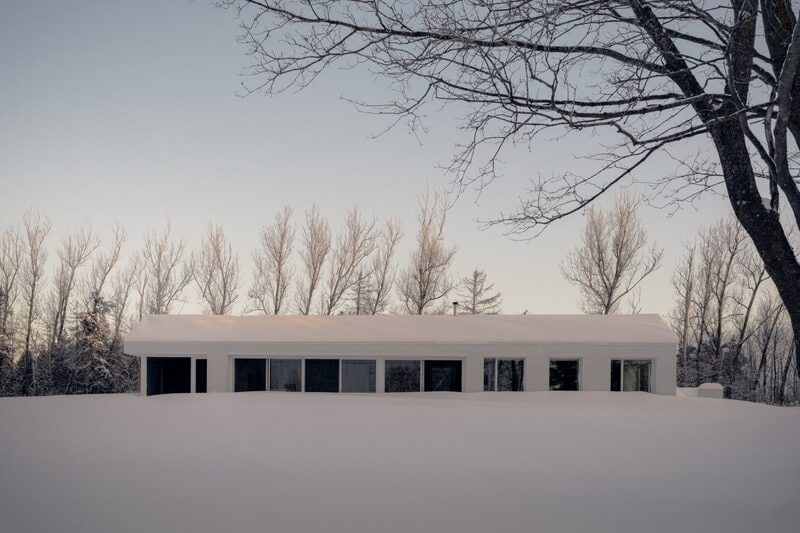
The Timbertop House by Atelier Kastelic Buffey anchors in Canada’s wooded terrain with a two-storey residence designed to respond to seasonal conditions and forest context near Mont-Tremblant, Quebec. The house is elevated on concrete footings and steel columns to minimise disturbance to the sloping site, with a long, linear plan arranged along the ridge to capture daylight and frame views of surrounding pines and deciduous trees. Exterior cladding uses locally sourced wood that will weather naturally over time, reinforcing the connection to the landscape while supporting low maintenance and material authenticity.
Large glazed façades face south and west to optimise passive solar gain and visual connection to the outdoors, while shaded overhangs and deep eaves control heat and glare during summer months. Internally, the open-plan main floor accommodates living, dining, and kitchen zones that flow toward a covered veranda, and bedrooms on the upper level access outdoor terraces through generous openings. A restrained material palette of timber, stone, and concrete supports thermal mass and acoustic comfort, and built-in joinery integrates storage and seating to reduce the need for added furniture.
Image Credit: Félix Michaud.
What Makes This Trend Stand Out
- Sustainable Timber Architecture
- Timber structures using locally sourced materials reflect a growing trend towards sustainability, offering opportunities to innovate with eco-friendly building techniques.
- Passive Solar Design
- Designs that capitalize on passive solar energy through strategic placement of glazed façades present possibilities for energy efficiency improvements in residential construction.
- Minimalist Open-plan Living
- The adoption of open-plan layouts that seamlessly integrate functional zones invites innovations in space-saving furniture and multifunctional interior design.
Sectors Adopting This
- Green Building Materials
- As demand for environmentally responsible construction rises, the industry can benefit from developing materials that enhance the durability and sustainability of homes.
- Energy-efficient Windows
- The focus on optimizing passive solar gains highlights opportunities for advancements in window technologies that enhance insulation and control.
- Custom Furniture Design
- Incorporating built-in joinery offers the furniture design industry a chance to create bespoke solutions that maximize space and maintain aesthetic coherence in modern homes.