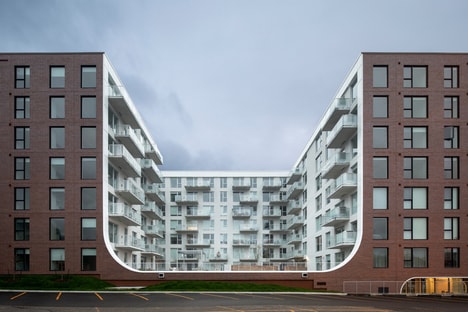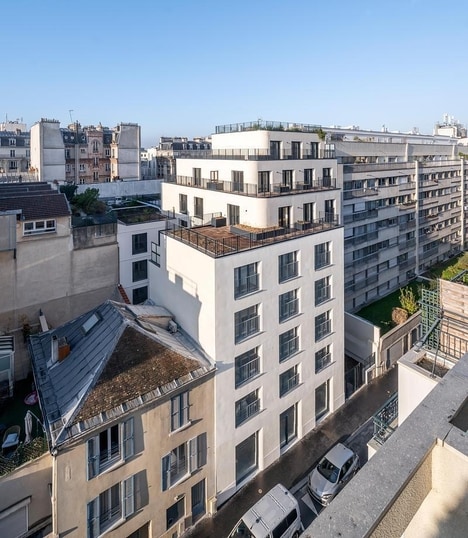
ACDF Architecture has designed Vivre 2 — a residential project in Montreal's Outremont borough that demonstrates a thoughtful approach to integrating new housing into a post-industrial landscape. The firm drew inspiration from the district's industrial character and, in doing so, created a dialogue between past and present that preserves and reveals the site's unique spirit.
The Vivre 2 building's massing recalls the former warehouses that once defined the area, yet is enlivened by a subtle diagonal fragmentation on one of the main façades. Glass guardrails climb from the ground-floor lobby and commercial space up to the top floors, breaking up the monolithic volume while maintaining its unity and injecting a contemporary dynamism. The material palette of the residential project features two shades of clay brick, with one highlighting the structural grid to echo the old concrete frames and pragmatic brick industrial buildings of the area. The other fills the intervals.
Image Credit: Adrien Williams
Key Themes Behind This Trend
- Post-industrial Housing
- Adaptive residential design in former industrial districts creates value by preserving local character while introducing contemporary density and mixed-use livability.
- Contextual Facades
- Architectural envelopes that reinterpret historic materials and structural rhythms offer differentiation in urban developments seeking authenticity without relying on replication.
- Fragmented Massing
- Subtle geometric breaks in large building volumes present opportunities to make dense housing feel more dynamic, human-scaled, and visually connected to its surroundings.
Where This Applies
- Residential Real Estate
- Developers can benefit from projects that blend heritage-inspired design with modern housing needs in neighborhoods transitioning from industrial to residential use.
- Architecture and Design
- Firms are finding new relevance in approaches that translate industrial memory into contemporary forms, materials, and façade strategies.
- Urban Development
- City-building efforts in post-industrial areas are increasingly shaped by residential projects that balance densification, placemaking, and cultural continuity.