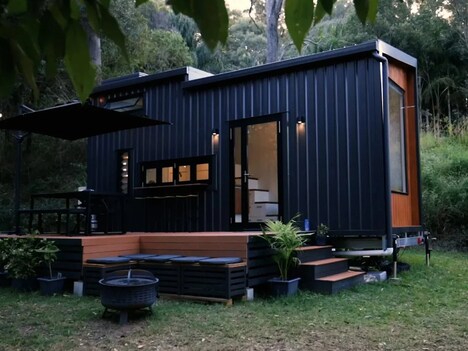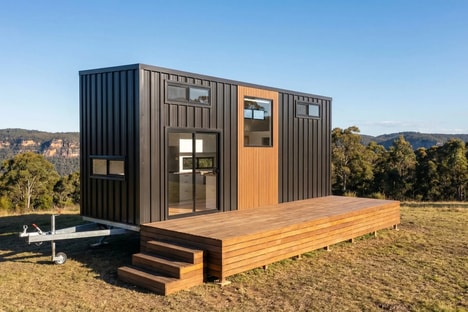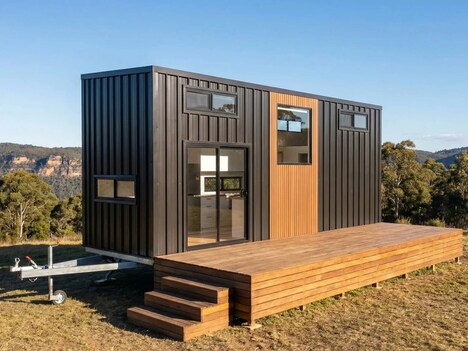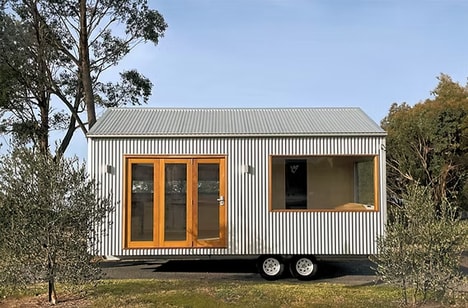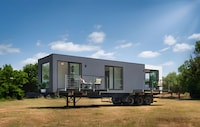
The Removed Tiny Homes Coolangatta 8.4 tiny house has been designed by the Australia-based outfit as a mobile home that taps into demand for stylish models that are both durable and realistic for everyday living.
The tiny house is based on a triple-axle trailer and clad in Colorbond steel to give it a durable profile that can withstand exposure the Australian climate. The interior features a stylish design that's packed with storage to give it a realistic layout for everyday living. The main bedroom sits over the kitchen and bathroom, while the secondary bedroom sits over the living room but could also function as a supplemental living space if not used for a bedroom.
The Removed Tiny Homes Coolangatta 8.4 tiny house is powered by a standard RV-style hookup, but can also be used with a roof-based solar power system.
Image Credit: Removed Tiny Homes
What's Driving This Trend
- Durable Steel-clad Tiny Homes
- Steel Colorbond exteriors provide weather-resistant shells that significantly extend the usable lifespan of mobile residences in extreme climates.
- Storage-optimized Micro Living
- Highly integrated storage layouts prioritize multi-functional spaces and enable realistic everyday living within compact footprints.
- Solar-ready Mobile Dwellings
- Roof-mounted solar compatibility paired with standard RV hookups allows off-grid operation and energy resilience for nomadic households.
Who This Affects Most
- Residential Construction
- Adoption of durable cladding and compact design principles can shift small-footprint housing toward longer-lasting, lower-maintenance build standards.
- Recreational Vehicle Manufacturing
- Integration of home-like interiors and climate-hardy exteriors points to a blurring of RV and permanent housing markets with new product categories.
- Modular Furniture and Storage Solutions
- Demand for clever storage in tiny homes drives innovation in customizable, space-efficient fittings that serve multiple functions within constrained layouts.