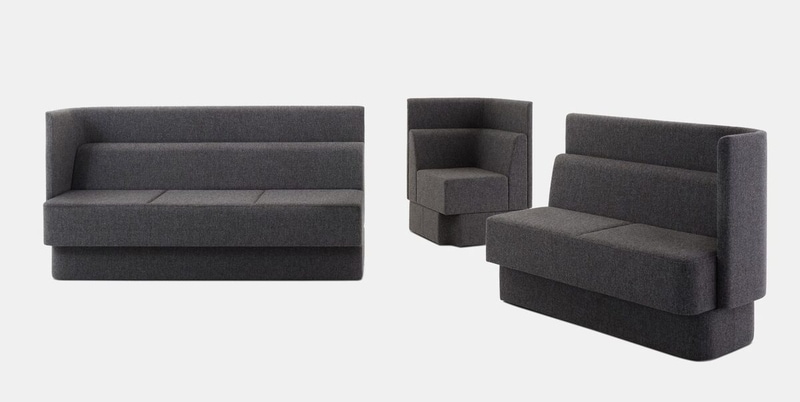
NaughtOne has expanded its Pullman collection with Pullman Modular, a seating system designed to shape workplace environments without the need for permanent partitions. Building on the original Pullman chair pod, the collection retains the high-back profile, upright seating posture, and floor-length upholstery while introducing a modular format that can be scaled and reconfigured over time. Available in multiple module sizes, the system allows designers to create enclosed work settings, informal meeting areas, and breakout spaces within open-plan interiors.
The collection is intended to function as both furniture and a spatial planning tool. Two back-height options and varying wing depths allow different levels of privacy while maintaining a consistent visual language across large projects. Modules can be combined, rearranged, and repurposed as workplace requirements change.
Image Credit: NaughtOne
What Makes This Trend Stand Out
- Modular Workspace Enclosures
- Flexible, connectable seating modules enable the rapid redefinition of spatial boundaries inside open-plan offices, creating opportunities to rethink interior layouts as serviceable assets rather than fixed infrastructure.
- Adaptive Privacy Seating
- High-back, configurable seats with variable wing depths and heights introduce graduated acoustic and visual privacy layers that challenge the need for traditional enclosed meeting rooms.
- Scalable Furniture-as-architecture
- Reconfigurable furniture systems that function as both seating and spatial dividers present a model where built environment functions can be scaled, leased, or updated independently from core building structures.
Sectors Adopting This
- Corporate Office Design
- Design firms can leverage modular seating to deliver adaptable workplace strategies that shift focus from static floorplans to configurable experience-driven environments.
- Commercial Real Estate
- Landlords and property managers face the possibility of differentiating assets by offering flexible, reconfigurable interior systems that respond to tenant needs without costly renovations.
- Furniture Manufacturing
- Producers of contract furniture are positioned to expand into integrated spatial solutions and subscription-based models as demand grows for products that serve both furnishing and architectural roles.