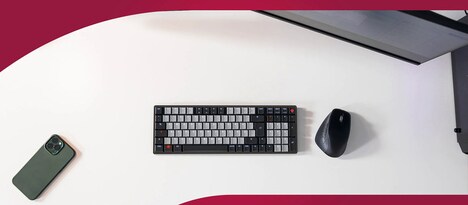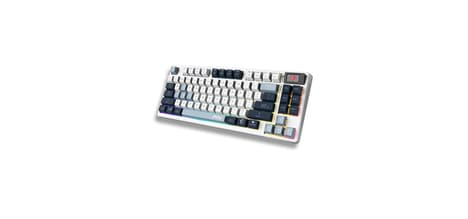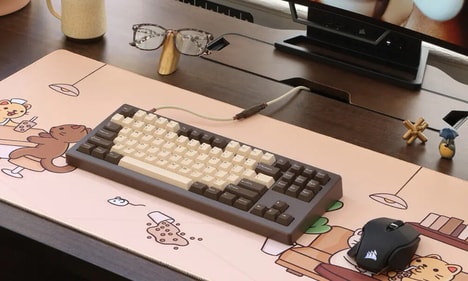
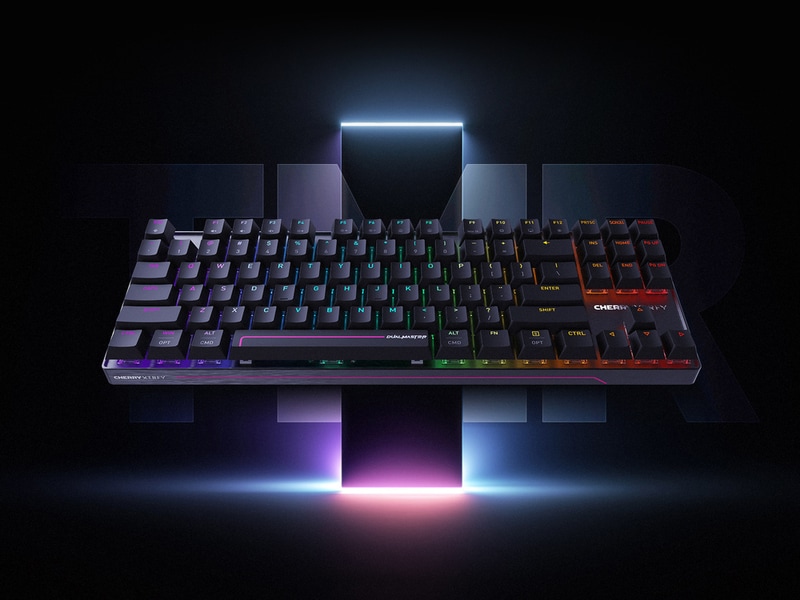
Cherry introduced the MX 8.2 Pro TMR TKL, a tenkeyless gaming keyboard featuring tunnel magnetoresistance (TMR) sensors designed to register ultra-precise keystrokes and faster response times. The board was launched with a sturdy metal top plate, PBT keycaps, and a compact TKL layout, with RGB lighting controlled via Cherry Mag Crate software.
The keyboard includes Dynamic Keystroke (DKS) allowing up to four actions per key across 0.1 mm–3.2 mm actuation, rapid trigger for quick release registration, and five-layer internal sound dampening for a softer typing profile. Battery life reaches up to 300 hours in Bluetooth mode and the software now defaults to English after an initial language issue.
For competitive players this tech offers snappier inputs and fine-tuned actuation, while casual users may not notice large gains over Hall effect or mechanical boards. The MX 8.2 Pro TMR TKL signals a shift toward magnetic sensing in peripherals, spotlighting TMR as a high-precision option for future keyboard designs.
Image Credit: Cherry
Key Themes Behind This Trend
- Magnetic Sensing Peripherals
- The shift to TMR and other magnetic sensors enables far higher positional accuracy and durability compared with traditional mechanical switches, enabling new input paradigms that rely on sub-millimeter actuation precision.
- Adaptive Multi-action Keystrokes
- Dynamic keystroke layers and variable actuation depths create potential for keys to register multiple distinct commands across a single physical input, expanding interface complexity without adding hardware footprint.
- Ultra-quiet Premium Tactility
- Advanced multi-layer sound dampening combined with refined materials produces high-end silent typing profiles that redefine user expectations for premium comfort and acoustic discretion.
Where This Applies
- Gaming Peripherals
- Competitive gaming hardware can exploit faster, high-precision magnetic sensing to reduce input latency and enable new tournament-focused customization of actuation and feedback.
- Professional Productivity Hardware
- Workstation keyboards and control surfaces that incorporate multi-action keys and quiet precision could reshape professional workflows by compressing complex macros and shortcuts into single-key, low-noise inputs.
- Wearable Input Devices
- Miniaturized magnetic sensors and variable-actuation logic present opportunities for compact, low-power wearable controllers that translate subtle motions into discrete multi-state inputs.