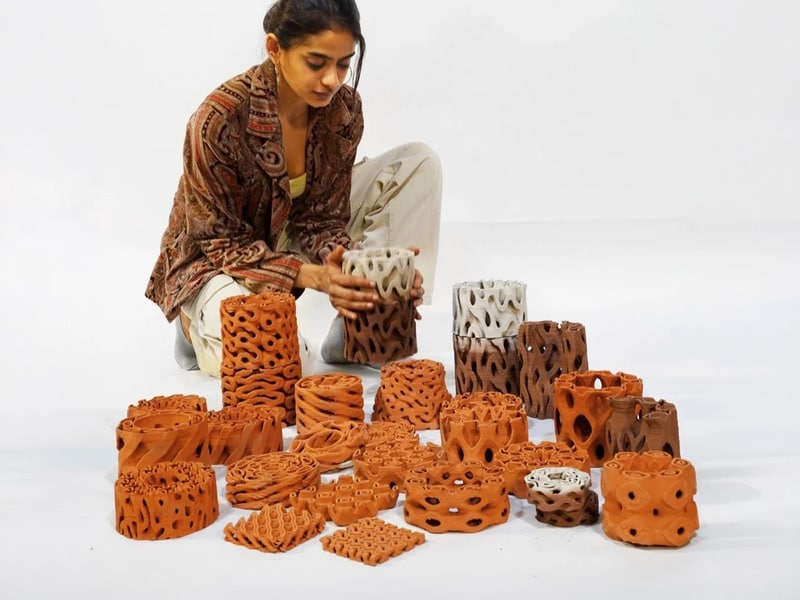
Minimal Matter is a terracotta building system developed by Rameshwari Jonnalagedda. Produced through additive manufacturing, the project uses geometries derived from minimal surfaces found in natural structures such as soap films, leaf veins, and cellular membranes. The 3D-printed clay modules feature porous forms that can be configured for different architectural applications. Depending on geometry and arrangement, the units can function as structural components, thermal surfaces, or habitat-supporting elements. The project was recognized in the Young Talents category of the Design Intelligence Award.
The modules are fabricated from terracotta using a layer-by-layer printing process that leaves visible deposition lines across the surface. Individual units can be stacked, combined, and reconfigured into larger assemblies while maintaining a consistent geometric language. The porous structures are designed to accommodate air, light, insects, moss, and other forms of biological growth.
Image Credit: Rameshwari Jonnalagedda
What Makes This Trend Stand Out
- 3d-printed Bioceramics
- Additive clay fabrication introduces low-waste architectural components with tunable porosity, thermal behavior, and structural roles for more adaptable built environments.
- Bio-receptive Architecture
- Porous terracotta geometries create building surfaces that can host insects, moss, airflow, and light, expanding architecture into habitat-supporting infrastructure.
- Minimal-surface Design
- Nature-derived geometries offer lightweight, high-performance forms that merge aesthetic consistency with material efficiency across modular construction systems.
Sectors Adopting This
- Architecture
- Configurable clay modules point to buildings with integrated structure, climate moderation, and ecological functions embedded directly into architectural surfaces.
- Construction Materials
- Terracotta-based additive manufacturing signals a shift toward recyclable, locally producible components that reduce dependence on conventional high-carbon materials.
- Urban Biodiversity
- Habitat-supporting facade and wall systems suggest new roles for construction products in improving ecological connectivity within dense urban settings.