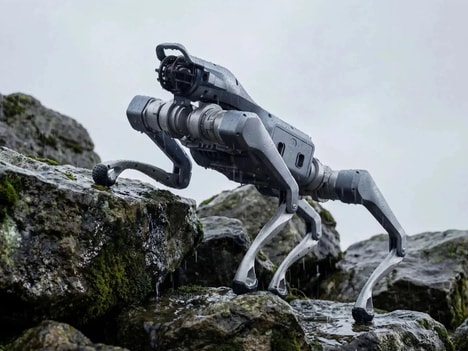
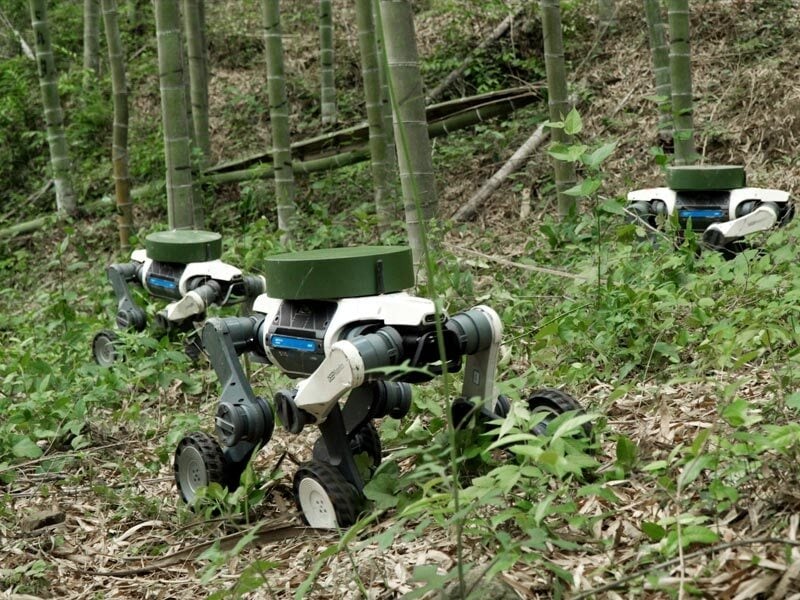
The DEEP Robotics Lynx S10 is a lightweight robotic dog engineered to easily tackle demanding terrain thanks to an ultra-agile construction. The robot weighs in at les than 20-kilograms and is engineered with 16 high-precision joints that allow it to easily shift across terrain or traverse environments that would otherwise be too difficult. The robot can reach a maximum speed of 8 m/s when on flat ground and can accommodate for obstacles up to 0.5-meter to work well in most scenarios.
The DEEP Robotics Lynx S10 is outfitted with autonomous path planning technology and obstacle avoidance, and has an IP66 rating as well as the ability to operate in extremely cold and hot temperatures. The robot can support up to 120-kilograms of weight and can balance on as few as one of its four wheels.
What's Driving This Trend
- Ultra-agile Legged-wheeled Hybrids
- These compact platforms that combine legged mobility with wheel stabilization enable traversal of complex terrains while maintaining high-speed efficiency, opening pathways for new payload and service models in mobile robotics.
- Ruggedized Autonomous Field Robotics
- Robots built to IP66 standards and extreme-temperature tolerances support prolonged outdoor deployment in harsh environments, creating opportunities for persistent sensing and maintenance capabilities previously limited by durability.
- High-precision Multi-joint Locomotion
- Systems employing numerous high-precision joints deliver fine-grained adaptability to obstacles and uneven ground, enabling manipulation of loads and interactions in unstructured settings that traditional wheeled robots cannot manage.
Who This Affects Most
- Infrastructure Inspection and Maintenance
- Inspection workflows for bridges, pipelines, and power lines could be transformed by durable, agile robots capable of navigating confined and elevated structures while carrying inspection sensors and repair tools.
- Search and Rescue Operations
- Disaster response capabilities may be enhanced by lightweight, all-terrain robots that can penetrate rubble, traverse unstable ground, and transport supplies or sensor packages where human access is dangerous.
- Logistics and Last-mile Delivery
- Urban and off-road delivery scenarios stand to benefit from small, fast robots that negotiate obstacles and variable surfaces while supporting significant payloads for decentralized distribution models.