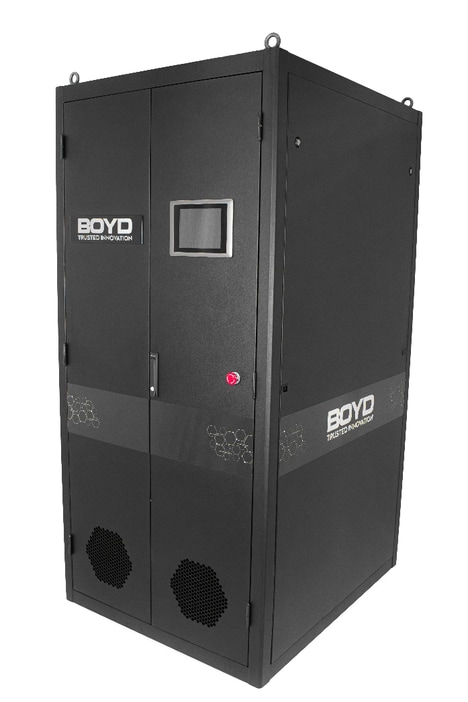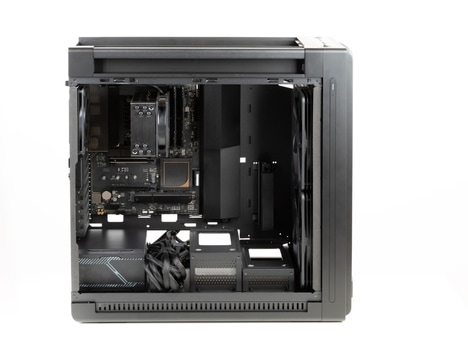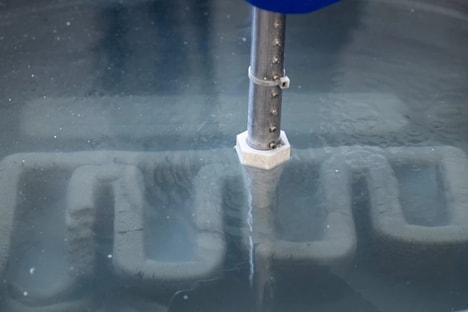
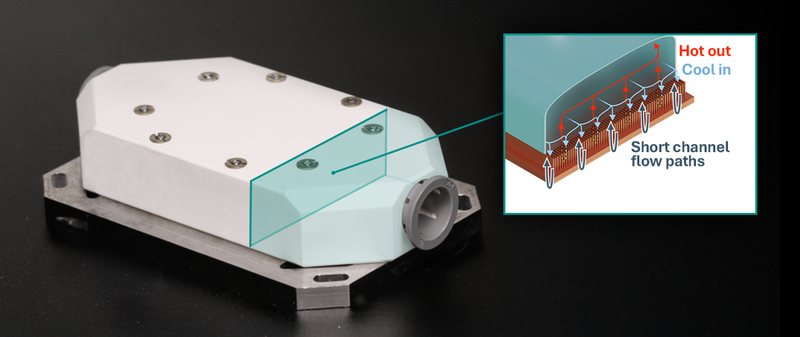
HRL Laboratories introduced Low-Chill, a 3D-printed direct liquid cooling (DLC) system developed with ARPA-E funding to improve data center thermal management, featuring a printed manifold that routes coolant through hundreds of short flow paths. The system is single-phase, meaning it cools without vaporizing and recondensing the coolant, which simplifies infrastructure compared with two-phase approaches.
HRL reported that Low-Chill boosted cooling capacity by about 40% at equivalent pumping power and that the design scales to multi-chip modules and next-generation processors. Built to fit existing data center architectures, the solution targeted operational constraints and energy use, offering higher thermal density without wholesale facility redesign. For operators, Low-Chill promises lower energy demand and greater performance-per-watt, aligning with industry trends toward direct liquid cooling and tighter chip-level thermal control.
Image Credit: HRL Laboratories
What Makes This Trend Stand Out
- 3d-printed Cooling Manifolds
- The use of additive manufacturing to produce complex coolant channels enables bespoke, high-density thermal pathways that can dramatically reduce pumping power for equivalent cooling.
- Single-phase Direct Liquid Cooling
- Cooling systems that avoid phase change simplify facility infrastructure and create opportunities for compact, reliable thermal management with predictable performance scaling.
- Chip-level Thermal Integration
- Embedding tailored cooling interfaces at the multi-chip and processor level supports much higher thermal density and tighter performance-per-watt optimization across heterogeneous computing stacks.
Sectors Adopting This
- Data Center Infrastructure
- Operators stand to realize significant reductions in energy demand and floor-space constraints by adopting direct liquid cooling architectures compatible with existing deployments.
- Semiconductor Manufacturing
- Processor and module designers could leverage integrated liquid manifolds to push die power envelopes and package-level performance without extensive redesign of chips.
- High-performance Computing
- Supercomputing centers may achieve higher sustained compute density and lower cooling overhead through tailored single-phase liquid systems that match node-level thermal profiles.