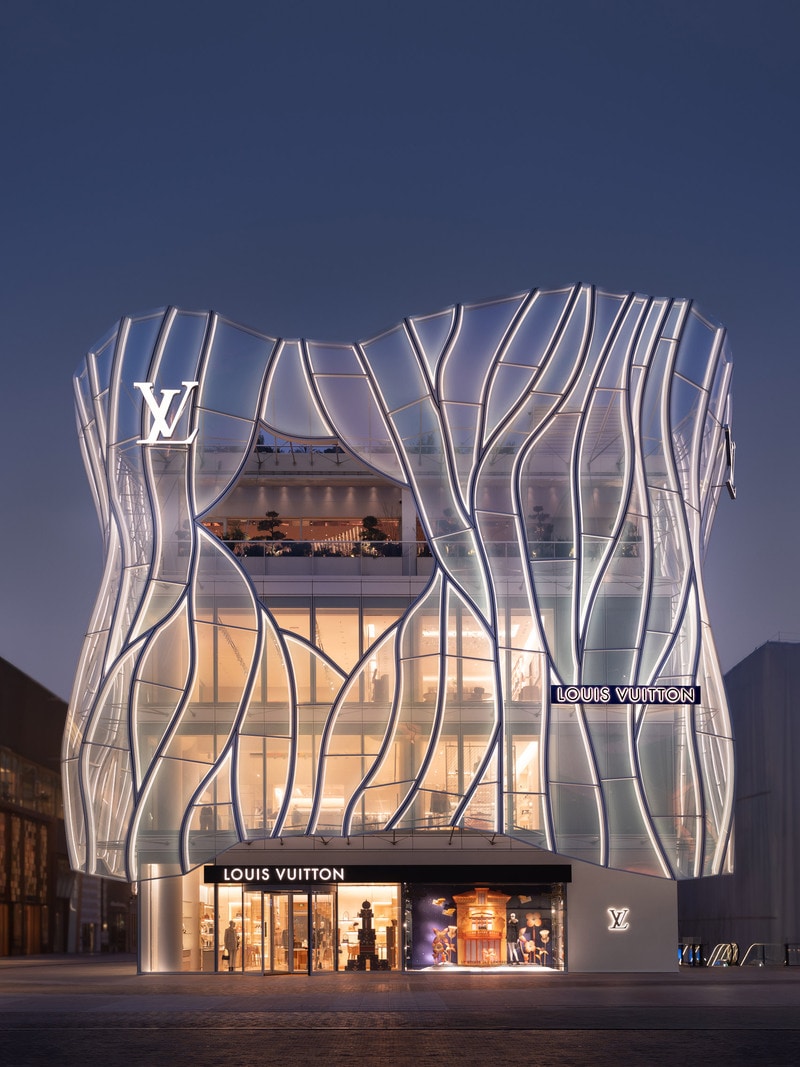
Maison Louis Vuitton Sanlitun is a new flagship building in Beijing’s Sanlitun district designed by Japanese architect Jun Aoki. Located within the Taikoo Li Sanlitun retail complex, the four-storey structure replaces an earlier store with a purpose-built architectural form. The building features a sculptural exterior composed of layered, translucent surfaces that create a sense of movement and depth. Its curved geometry distinguishes it from the surrounding orthogonal buildings while responding to the dense urban context of the shopping district.
Inside, the flagship is organised around a central vertical space that connects retail areas across multiple levels. The interior layout accommodates fashion, accessories, and lifestyle collections, with circulation designed to guide visitors upward through the building. Material choices and lighting are used to create visual continuity between floors while maintaining clear spatial zones. The project reflects Jun Aoki’s long-standing collaboration with the fashion house and his approach to integrating architecture, branding, and urban presence within a single structure.
Image Credit: Louis Vuitton
Why This Trend Is Growing
- Sculptural Retail Architecture
- Innovative architecture featuring sculptural exteriors offers brands an opportunity to differentiate themselves in crowded urban environments.
- Experiential Luxury Spaces
- The integration of unique interior layouts and design elements in luxury buildings enhances consumer experiences beyond traditional shopping.
- Seamless Spatial Zoning
- Design elements that maintain visual continuity while defining distinct spatial zones can optimize visitor flow and interaction in multi-level retail spaces.
Industries Being Reshaped
- Luxury Fashion Retail
- Luxury fashion brands are increasingly investing in architecturally distinct flagship stores to enhance brand identity and customer engagement.
- Urban Architectural Design
- Urban centers are embracing cutting-edge architectural designs that integrate functionality with aesthetic appeal to attract premium retailers.
- Experiential Marketing
- Brands are turning to immersive architectural designs as a form of experiential marketing, blending physical spaces with brand storytelling.