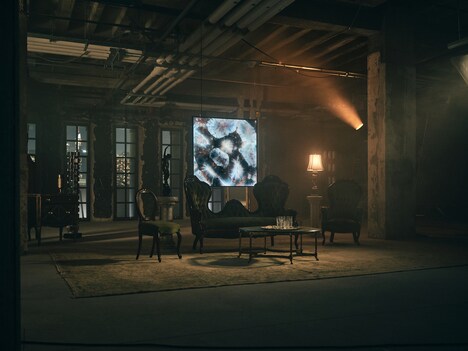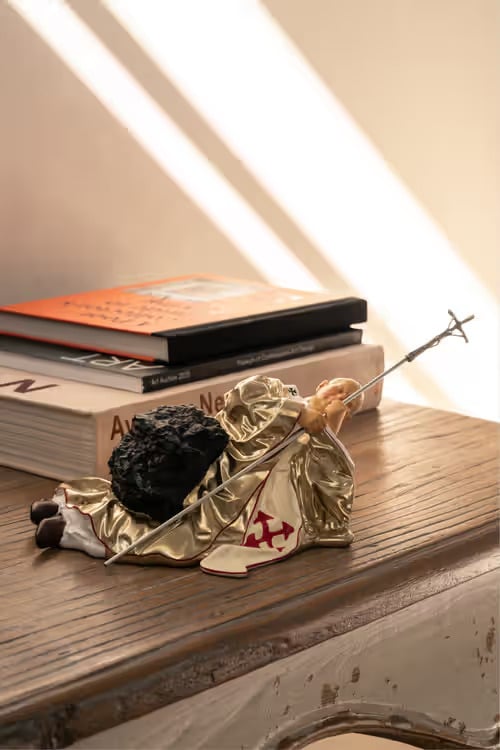
La Nona Ora is a sculptural work by Maurizio Cattelan that depicts Pope John Paul II struck down by a meteorite, originally created in 1999. The piece is known for its hyperrealistic staging and controversial use of religious imagery, showing the Pope collapsed on a red carpet beneath a large stone. La Nona Ora has been interpreted as a reflection on fragility, belief, and institutional power, and remains one of Cattelan’s most recognized works.
The latest project revisits the work through a campaign titled “The Confessional,” which invites participants to submit voice messages confessing personal thoughts or actions. The initiative accompanies a limited edition release of miniature versions of the sculpture, produced as collectible objects. The rollout aligns participation with ownership, linking audience interaction to the artwork’s distribution.
Image Credit: Avant Arte
What's Driving This Trend
- Participatory Confessional Art
- A surge in projects soliciting private narratives as artistic material is enabling artworks to function as communal archives that blur creator-audience boundaries.
- Collectible Miniature Releases
- Limited-edition scaled reproductions tied to participation are reframing how scarcity and personal connection drive secondary-market value.
- Controversial Religious Imagery Revival
- Renewed use of sacred symbols in provocative contexts is prompting new conversations about institutional critique and audience polarization around cultural content.
Who This Affects Most
- Art Market and Collectibles
- Market dynamics are shifting as participatory provenance and narrative-linked editions create novel valuation models beyond traditional artist reputation.
- Digital Platforms and Audio Archives
- Platforms that host user-submitted confessions and preserve ephemeral audio content are emerging as critical infrastructure for experiential and participatory art.
- Museums and Cultural Institutions
- Exhibition programming is evolving to incorporate interactive confession-based installations that challenge curatorial norms and visitor engagement metrics.