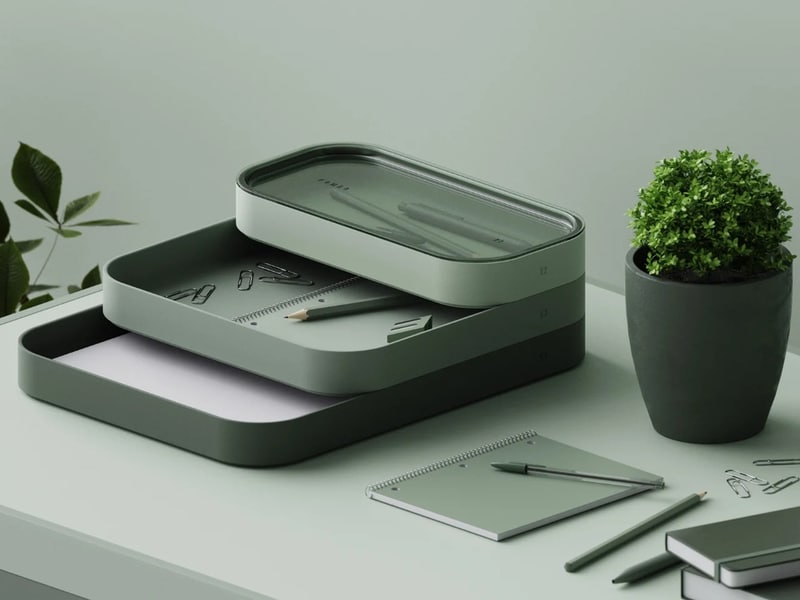
The KOMBO desk organizer reimagines desktop storage through a stepped landscape inspired by terraced rice fields, translating topography into a functional surface. Designed as a continuous form rather than divided compartments, it uses raised and recessed levels to hold pens, notes, and small objects in place. The design avoids rigid slots, instead allowing items to rest across varying heights, creating a more flexible and visually open system for organizing everyday tools.
The layered structure defines placement through elevation, where each tier acts as both boundary and usable surface. This arrangement keeps objects visible while subtly grouping them without enclosure. The form draws from agricultural terraces, applying their repetitive geometry to a compact desk format. By replacing traditional compartmentalization with a sculpted surface, the organizer shifts workspace storage toward a more spatial and visually integrated approach.
Image Credit: Mirko Romanelli
What's Driving This Trend
- Layered Surface Storage
- A move toward stepped, multi-height surfaces that define placement without walls opens possibilities for integrated storage that reads as sculptural desktop terrain.
- Topography-inspired Design
- Design language borrowed from landscapes and agricultural terraces is being translated into compact consumer objects that emphasize elevation and flow over compartmental separation.
- Flexible Non-compartmental Organization
- Products increasingly favor continuous forms that accommodate varied item sizes and informal grouping instead of fixed slots, enabling adaptable visual clarity on work surfaces.
Who This Affects Most
- Office Accessories
- Retailers and brands can exploit sculpted organizer geometries to offer premium desk ecosystems that combine aesthetics with adaptable utility for diverse work tools.
- Interior Design and Architecture
- Spatial planning and furniture design may incorporate terraced motifs to create modular, multi-level storage strategies that read as architectural features within workspaces.
- Product Design and Manufacturing
- Manufacturers capable of producing continuous, layered forms through tooling or additive processes are positioned to introduce a new category of unified, material-efficient organizers.