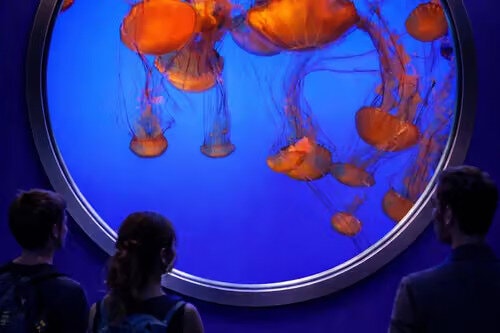
The Jellyfish Museum has officially opened in Pompano Beach, Florida, becoming the first facility in the United States dedicated exclusively to jellyfish. Founded by Ukrainian refugees Alex and Yana Yanovsky, the 10,000-square-foot destination houses roughly 20 species across 21 specialized saltwater tanks, surrounded by immersive digital environments. The couple brings more than two decades of aquarium experience to the project, having previously operated a jellyfish-focused attraction in Kyiv before leaving Ukraine during the 2022 Russian invasion.
The museum occupies a former Wells Fargo bank branch and pairs its glowing tanks with five-meter-high 3D projections designed to simulate drifting through open water. Current inhabitants include Japanese sea nettles, spotted jellies, and upside-down jellyfish, with marine life sourced through licensed aquaculture partners. Beyond the visual experience, the Jellyfish Museum also provides educational context around the animals, from their simple nerve networks to the roughly 4,000 known jellyfish species worldwide.
Image Credit: Jellyfish Museum, hypebeast
What Makes This Trend Stand Out
- Bio-immersive Exhibits
- Glowing live-animal displays paired with projection mapping create new forms of sensory education that blend nature, art, and entertainment.
- Adaptive Venue Reuse
- Former commercial spaces such as bank branches can be transformed into destination attractions that give underused real estate experiential cultural value.
- Aquaculture-based Attractions
- Licensed marine breeding networks enable specialized wildlife venues to showcase delicate species while reducing reliance on wild collection.
Sectors Adopting This
- Museums and Cultural Attractions
- Specialized single-species institutions expand the museum model with niche experiences that compete in the growing market for immersive leisure.
- Experiential Entertainment
- Digital environments surrounding live ecosystems point to hybrid attractions where technology enhances emotional engagement with science and nature.
- Marine Education
- Public-facing aquarium formats offer accessible platforms for teaching biodiversity, conservation, and ocean literacy through visually memorable encounters.