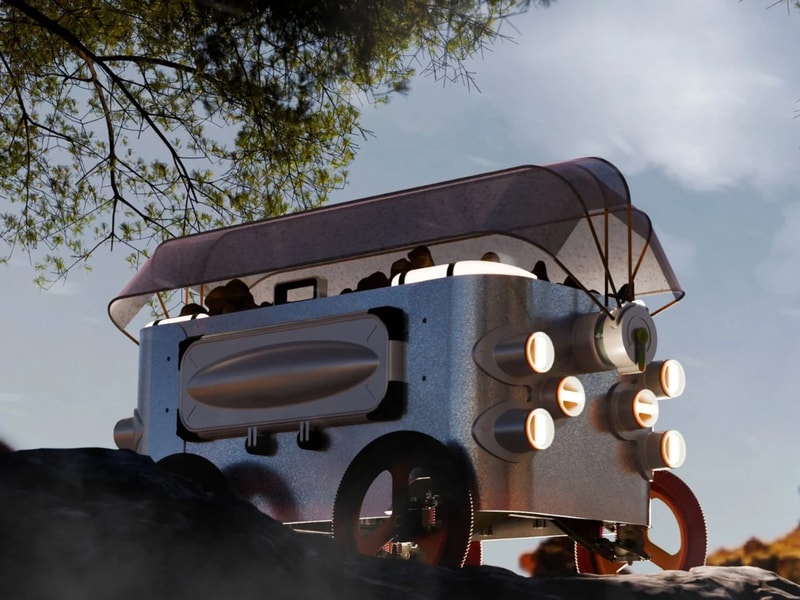
Hyve is an autonomous beekeeping vehicle designed by Nicolas Nielsen and recognized as a finalist in the 2026 Rimowa Design Prize. The concept combines a mobile transport platform with an integrated habitat for bee colonies. Its compact body houses a dedicated colony chamber beneath a translucent mesh canopy that provides ventilation, protection and light diffusion. Circular entry ports positioned along one side of the vehicle allow bees to enter and exit the habitat, while the enclosed structure is designed to support colony activity during transport and deployment.
The vehicle is built around a layered internal system that separates the living habitat from its mechanical components. A habitat tray containing comb and natural nesting materials sits above a ventilated partition, while a hydrogen fuel cell system occupies the lower section of the chassis. Four independently driven wheels are mounted to a tubular frame that supports the vehicle's autonomous operation.
Image Credit: Nicolas Nielsen
Key Themes Behind This Trend
- Autonomous Pollination
- Self-navigating bee habitats introduce new models for precision crop support, where mobile colonies can be deployed based on bloom cycles, farm geography and pollinator demand.
- Mobile Micro-habitats
- Compact transportable ecosystems signal opportunities in climate-adaptive conservation tools that protect vulnerable species while enabling flexible placement across changing environments.
- Clean-powered Agri-robotics
- Hydrogen-powered autonomous platforms create potential for low-emission field robotics that combine ecological services with continuous off-grid operation.
Where This Applies
- Agriculture
- Farms gain access to more responsive pollination infrastructure as autonomous habitats connect crop productivity with real-time mobility and managed biodiversity.
- Environmental Conservation
- Pollinator protection programs benefit from habitat systems that merge species support, monitoring potential and adaptable deployment across fragmented landscapes.
- Robotics
- The robotics sector sees expanding white space in bio-integrated machines designed to transport, shelter and assist living organisms rather than simply automate mechanical tasks.