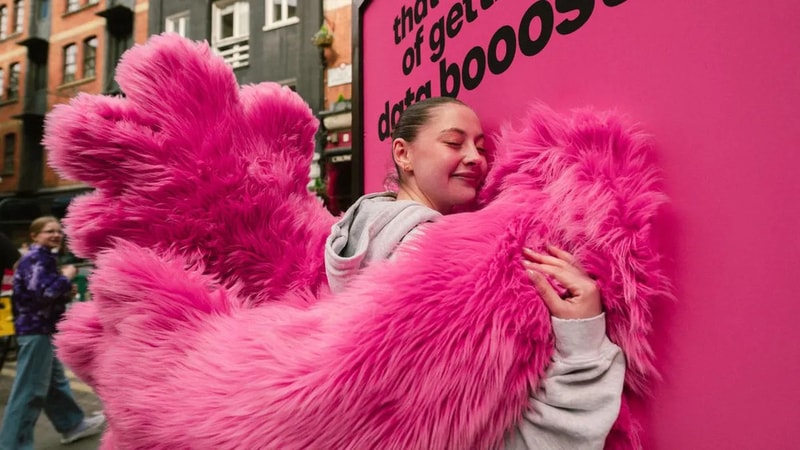
April 1st marks Price Hike Day in the UK, a date when various price increases for household bills come into effect, and mobile provider giffgaff, which protects its members from mid-contract price hikes, launched a Huggable Poster to share that same sense of comfort with passersby. The large, hot pink and unmissable activation takes the form of a custom billboard with memory foam and fuzzy arms that welcome people in public into a warm embrace. "While many other mobile providers are inflicting price rises on their customers, at giffgaff we’re taking a different path. We’re dishing out data boosts of up to 200%, delivering more value to our members with no added expense. And what does that feel like? Like a big hug," said Nerissa Abrahams, Head of Advertising at giffgaff.
On 1st April, people can look out for the Huggable Poster at Kings Cross St. Pancras.
What's Driving This Trend
- Tactile Out-of-home Advertising
- Physical, touchable ad installations that engage multiple senses are redefining public advertising formats and enabling brands to create memorable, shareable moments outside digital channels.
- Emotional Value Messaging
- Brand communications that foreground feelings of security and appreciation over transactional benefits are shifting consumer expectations about what services should deliver beyond price and features.
- Experiential Trust Signals
- Interactive activations that embody promises—such as comfort, reliability or protection—are emerging as tangible demonstrations of brand commitments that can reduce perceived risk.
Who This Affects Most
- Out-of-home Advertising
- Advertisers and production firms stand to be disrupted by immersive, sensor-enabled and tactile billboards that demand new fabrication techniques and cross-disciplinary creative teams.
- Telecommunications
- Mobile carriers could be transformed by positioning service guarantees as experiential benefits, prompting novel product packaging and customer retention models centered on perceived value.
- Retail and Public Spaces
- Shopping centers and transit hubs may evolve to host branded experiential installations that drive foot traffic and change how physical spaces are monetized and curated.