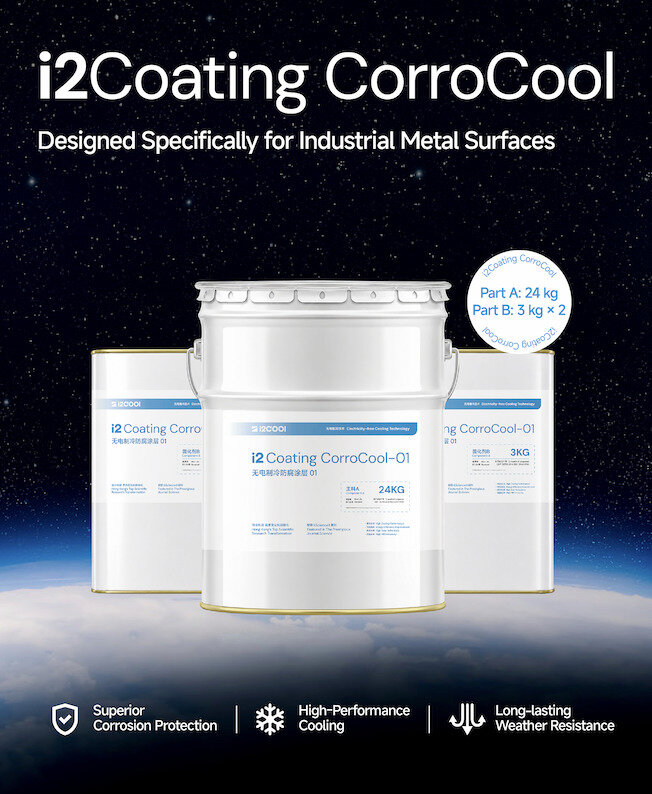
i2Cool has introduced i2Coating CorroCool, a silane-based functional coating engineered to simultaneously address two persistent threats to industrial metal assets — solar heat gain and corrosion.
i2Cool's i2Coating CorroCool represents a departure from conventional single-purpose protective functional coatings as it merges passive radiative cooling technology, which operates without electricity, with C5 high-durability corrosion protection rated for demanding environments. The coating is formulated with a high-solids silane polymer that forms strong chemical bonds with metal substrates, creating a dense physical barrier against moisture and corrosive agents while incorporating nano-functional particles that manage thermal loads. Its cooling capability is inspired by the natural heat-dissipation mechanisms of the Sahara silver ant, achieving at least 92% solar reflectance and 95% thermal emittance within the atmospheric window.
Image Credit: i2Cool
What Makes This Trend Stand Out
- Dual-function Coatings
- Multifunctional surface treatments are reshaping asset protection by combining thermal management and corrosion resistance in a single material system.
- Passive Radiative Cooling
- Electricity-free cooling surfaces present new pathways for reducing heat stress on infrastructure, equipment, and industrial facilities.
- Bio-inspired Materials
- Nature-derived engineering models such as Sahara silver ant heat dissipation are expanding the performance potential of advanced industrial coatings.
Sectors Adopting This
- Industrial Coatings
- High-solids silane formulations create opportunities for longer-lasting protective coatings designed for extreme operating environments.
- Infrastructure Maintenance
- Bridges, ports, pipelines, and metal structures could benefit from coatings that reduce both thermal degradation and corrosion-related repair cycles.
- Energy and Utilities
- Power plants, substations, and renewable energy assets gain relevance from passive cooling materials that support durability without added energy consumption.