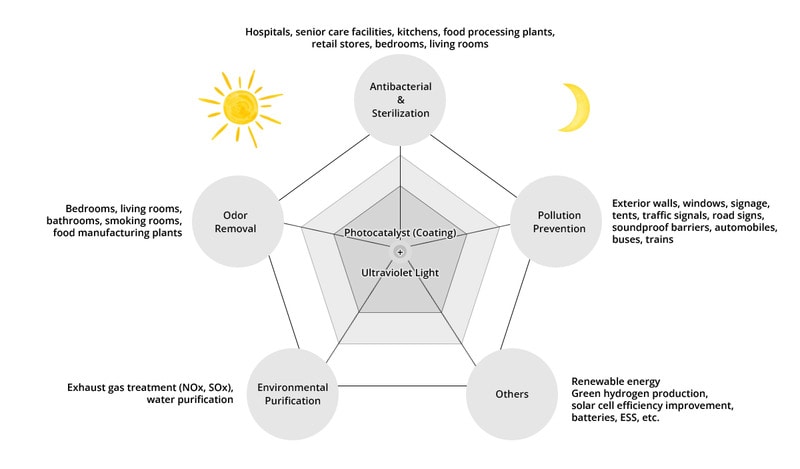
Raven Materials has developed a new class of catalyst — black TiO₂ — that operates under regular indoor lighting and sunlight. This is presented as a significant technical shift from earlier versions that required ultraviolet light to function. Thus, this advancement allows the material to harness a much broader spectrum of ambient light to initiate chemical processes that decompose organic pollutants, neutralize odors, and destroy microbial contaminants on surfaces.
Potential applications for Raven Materials' black TiO₂ technology are extensive, spanning from self-cleaning and antimicrobial paints and building materials to systems designed for producing green hydrogen fuel through solar-powered water splitting. As such, Raven Materials' innovation represents a notable progression in material science, moving photocatalytic capabilities from specialized, UV-dependent applications into more common environments and industrial processes.
Image Credit: Raven Materials
Key Themes Behind This Trend
- Broad-spectrum Photocatalysis
- The development of materials that function under both sunlight and regular indoor lighting expands the range of environments where photocatalytic processes can be employed, potentially transforming industries reliant on UV-light-dependent catalysts.
- Self-cleaning Materials
- The innovation of materials capable of decomposing organic pollutants and destroying microbial contaminants heralds a new era for surface treatments and coatings that maintain cleanliness autonomously.
- Green Hydrogen Production
- The integration of solar-powered water splitting systems using advanced catalysts points to a promising future for renewable hydrogen fuel production, enhancing sustainable energy projects.
Where This Applies
- Building Materials
- Raven Materials' new catalyst technology could revolutionize the construction industry by enabling self-cleaning and antimicrobial finishes in residential and commercial buildings.
- Coatings and Paints
- This breakthrough in photocatalytic materials can elevate the coatings industry through the production of paints that offer added functionalities like odor neutralization and antimicrobial properties.
- Renewable Energy
- The move towards catalysts that operate in ambient light conditions opens up vast possibilities for renewable energy sources, particularly in catalyzing the production of green hydrogen.