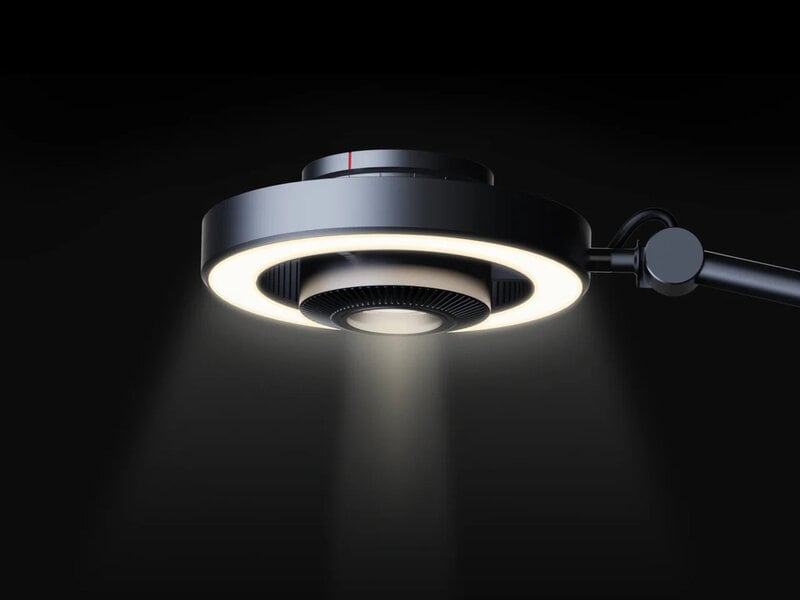
The Focus Light concept by Zhen Yang and Siting Lin combines two independently controlled light sources within a concentric lamp head to support both task lighting and ambient illumination. A central optical lens projects a concentrated beam for precision work, while an outer illuminated ring produces diffused lighting for broader desk coverage. Both sources are managed through a single rotary control positioned on top of the lamp. The space gray metal housing incorporates radial heat fins around the optical assembly, emphasizing thermal management alongside the minimalist industrial design.
The rotary knob transitions through three lighting configurations, activating the focused beam at 15 degrees, the ambient ring at 30 degrees and both light sources together at 60 degrees. A red indicator line provides clear visual feedback while allowing users to switch modes without digital controls or companion apps.
Image Credit: Zhen Yang, Siting Lin
Key Themes Behind This Trend
- Dual-mode Lighting
- Layered light sources in one fixture create new potential for workspaces that shift between precision tasks and relaxed ambient use.
- Analog Interface Design
- Physical rotary controls offer a differentiated alternative to app-connected products by making smart functionality feel immediate, tactile and intuitive.
- Thermal-aware Minimalism
- Visible heat-management features integrated into sleek product forms signal opportunities for performance-driven design that remains visually refined.
Where This Applies
- Home Office Furniture
- Desk accessories with adaptable lighting can expand the role of workstations as multifunctional environments for productivity, comfort and aesthetics.
- Consumer Electronics
- Compact devices that combine multiple functions through simple hardware controls reflect demand for technology that feels less screen-dependent.
- Lighting Design
- Hybrid task and ambient fixtures suggest fresh product categories for residential and commercial interiors seeking flexible illumination in a single object.