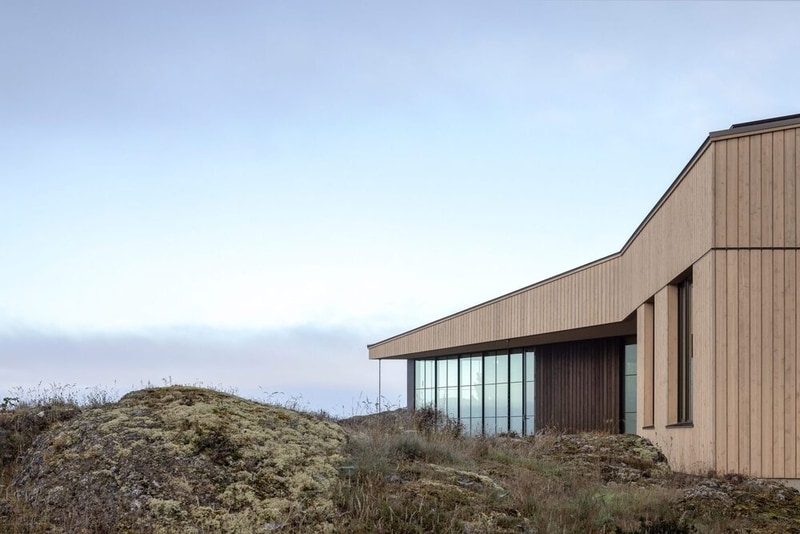
The False Bay house by Heliotrope Architects is a coastal residence located on San Juan Island in Washington, designed to respond to strong winds and exposed shoreline conditions. The house is positioned between two large rock outcrops, forming a compact footprint that fits within the site’s natural constraints. The layout directs views south toward the sea and north toward the rock formations while limiting exposure to neighboring properties. A gap between the structure and rock creates a sheltered terrace protected from prevailing winds.
The building uses a high-performance envelope with energy-efficient systems and integrated solar generation designed to approach net-zero energy use over a year. The structure is arranged in a “bowtie” plan that adapts to the terrain and wind patterns. Exterior surfaces and openings are oriented to manage exposure while maintaining views.
Image Credit: Sean Airhart
What Makes This Trend Stand Out
- Rock-framed Architecture
- Homes integrated between natural rock formations create protected microclimates that enable reduced structural footprints and material use.
- Wind-responsive Design
- Designs that orient massing and openings according to prevailing wind patterns reduce exposure while preserving panoramic views.
- Net-zero Coastal Homes
- Coastal residences combining high-performance envelopes and integrated solar generation support year-round near-net-zero energy balance despite harsh marine conditions.
Sectors Adopting This
- Residential Architecture
- Architectural practices focused on site-specific massing exploit topography and natural barriers to deliver compact, climate-adaptive dwellings.
- Renewable Energy Systems
- Distributed solar and energy-storage technologies tailored for low-visual-impact integration address energy resilience demands of remote coastal sites.
- Coastal Real Estate Development
- Developments prioritizing microclimate-protected parcels command premiums for privacy and reduced exposure to storm-driven erosion.