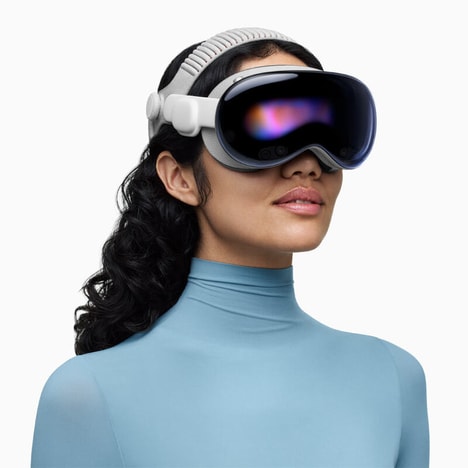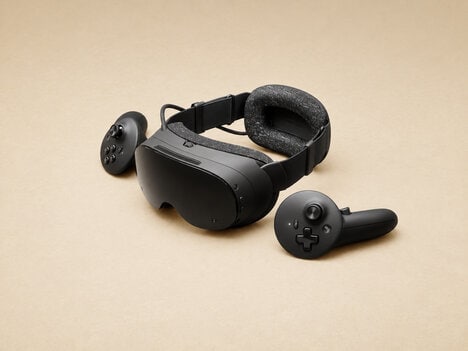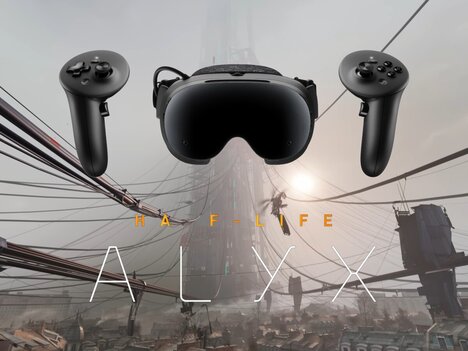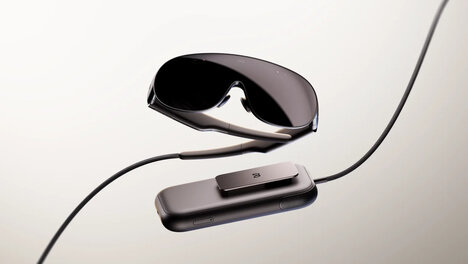
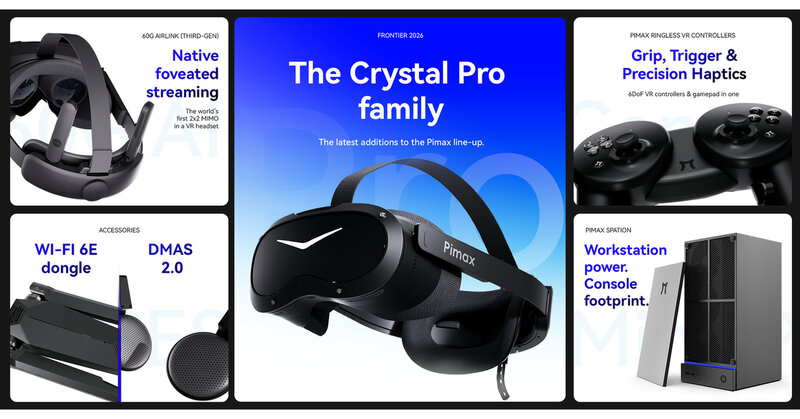
Pimax's 'Crystal Pro' delivers a wired-quality image to a wireless PC VR headset, letting players move more freely without sacrificing clarity at the center of view. Built around 'Native Foveated Streaming,' it sends the GPU's image only where the eyes are looking, keeping the headset sharp while cutting the usual encoding step.
The optional 'AirLink' kit uses a 60GHz connection and 2x2 MIMO, which means two antennas work together to push data more smoothly with lower lag. Crystal Pro also pairs QLED panels with aspheric glass lenses, plus eye-tracking and passthrough support, giving it a high-end spec sheet aimed at immersive PC play.
For shoppers, this means wireless VR can feel less like a compromise and more like a premium setup. Competing headsets now have to answer not just on resolution, but on how cleanly they move high-fidelity PC visuals off the cable.
Image Credit: Pimax
Why This Trend Is Growing
- Foveated Streaming
- Eye-position-based rendering concentrates bandwidth and GPU output on the user’s focal area, opening pathways for premium wireless visuals with lower latency and reduced processing overhead.
- Wireless Premium VR
- High-speed 60GHz connectivity is narrowing the gap between tethered and untethered headsets, creating room for more immersive gaming, training, and design experiences without cable constraints.
- Adaptive Visual Computing
- Systems that dynamically prioritize visual detail based on attention signals are reshaping performance expectations across spatial interfaces and high-resolution interactive media.
Industries Being Reshaped
- Virtual Reality
- The VR sector is moving toward headset architectures that combine eye tracking, passthrough, and advanced optics to deliver more comfortable high-fidelity experiences.
- Gaming Hardware
- PC gaming peripherals are gaining differentiation through wireless image delivery technologies that preserve responsiveness while supporting more natural player movement.
- Semiconductors
- Chipmakers and component suppliers have expanding relevance as foveated rendering, antenna systems, and display pipelines demand specialized performance for spatial computing devices.