
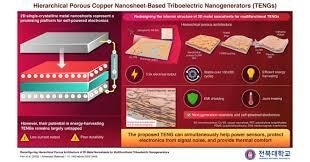
A research team from Jeonbuk National University has set its sights on efficient energy harvesting by developing a novel design for triboelectric nanogenerators (TENGs). The innovation utilizes a hierarchical porous architecture within two-dimensional copper nanosheets.
The researchers maintain that their design represents a materials science advancement that will help overcome historical limitations in wearable energy-harvesting technology, specifically addressing poor electrical output and mechanical fragility by restructuring the internal morphology of the metallic sheets.
The reconfigured material for efficient energy harvesting demonstrates substantially improved performance. It maintains functional stability across extensive stress cycles while also providing auxiliary capabilities such as shielding against electromagnetic interference and generating heat through electrical resistance. All of this is reportedly achievable via a scalable spray-coating fabrication method.
Image Credit: Jeonbuk National University
What Makes This Trend Stand Out
- Advanced Wearable Energy Solutions
- Rising demand for sustainable energy sources fuels interest in wearable energy-harvesting tech with improved electrical output and durability.
- Electromagnetic Shielding Innovations
- Nanogenerators now offer unexpected benefits like protection against electromagnetic interference, opening avenues in consumer electronics.
- Nano-fabrication Methods
- Scalable fabrication methods like spray-coating enable new applications for nanogenerators in diverse industries.
Sectors Adopting This
- Sustainable Wearable Technology
- The intersection of energy harvesting and wearable tech addresses energy efficiency, providing continuous power for smart devices.
- Electronics Manufacturing
- Triboelectric nanogenerators introduce opportunities for integrating multifunctional materials in electronic products.
- Materials Science
- Advancements in materials science using hierarchical porous structures in copper nanosheets pave the way for enhanced nanotechnology applications.