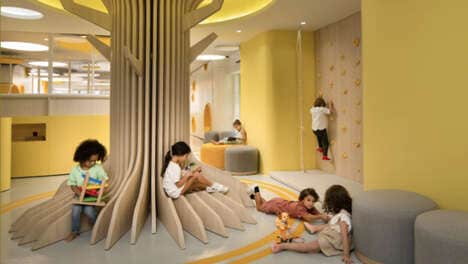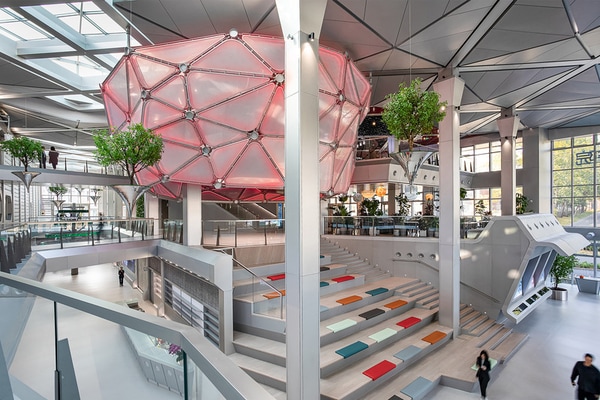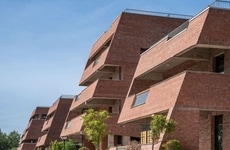

The Tongtai School, located in Ningjin County, Hebei Province, is a thoughtful educational institution design that strategically integrates learning environment functionality, ecological rehabilitation, and regional architectural identity. Designed by E PLUS/SZA DESIGN, this 59,560-square-meter campus accommodates students from kindergarten through high school, with a phased layout that organizes academic departments according to age groups while strategically positioning shared facilities like the library, art building, and playgrounds as connective hubs.
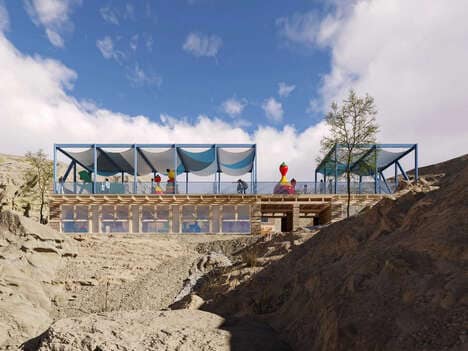
A defining feature of the educational institution design is its adaptive reuse of an adjacent abandoned brick kiln mine, an 18-meter-deep site covering 15,000 square meters. This sensibilityinfoorms both the school’s material palette and spatial strategy. The library and arts building extend into the mine pit, leveraging the terrain for natural ventilation and lighting, while the dining hall’s subterranean placement benefits from the pit’s thermal mass and expansive skylights. Red brick, a nod to the site’s industrial history, dominates the architecture, serving as both an aesthetic and functional element — its double-layer insulation mitigates northern China’s harsh winters, while deep window recesses provide summer shading without compromising natural illumination.
Image Credit: Weiqi Jin
Why This Trend Is Growing
- Ecologically-inspired Architectural Design
- Designs that incorporate natural terrains to enhance energy efficiency and environmental harmony are gaining traction, as seen in the adaptive reuse of the brick kiln mine at Tongtai School.
- Integrated Learning Environments
- The strategic design of educational spaces that cater to different age groups while providing common areas as community hubs is redefining traditional school layouts.
- Functional Historical Aesthetics
- The use of regionally significant materials, such as red brick at Tongtai School, is modernizing the approach to sustainability in architectural design while maintaining cultural identity.
Industries Being Reshaped
- Educational Infrastructure
- Innovative school architectures that blend learning-facility functionality with historical preservation are becoming pivotal in educational infrastructure development.
- Green Building and Construction
- Architectural practices that incorporate eco-friendly designs, like leveraging natural terrain for climate control, are transforming the green building industry.
- Sustainable Urban Planning
- The integration of adaptive reuse strategies in urban planning is highlighting new avenues for developing environmentally conscious educational precincts.