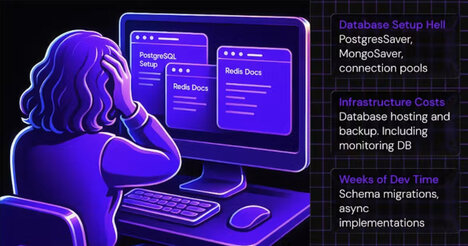
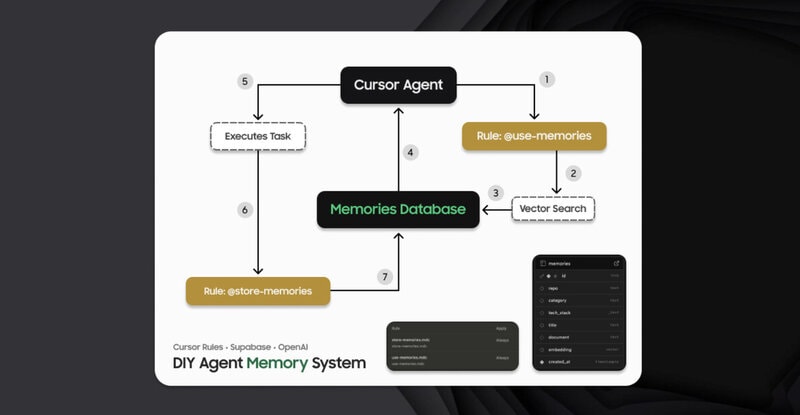
AI coding agents can lose valuable context between tasks, making it difficult to preserve useful insights, patterns, and decisions over time. Cursor Memories is a CLI tool designed to give Cursor agents a persistent memory system for storing and searching development knowledge. It uses Cursor Rules, Supabase, and OpenAI embeddings to organise information so agents can retrieve relevant memories when needed.
Developers can use the tool to preserve insights and patterns that might otherwise be forgotten between sessions. By adding a searchable layer of long-term context, Cursor Memories aims to help AI agents work with greater continuity and consistency. The tool provides developers with a practical way to build persistent memory into their AI-assisted development workflows.
This can help agents build on previous work instead of repeatedly starting from scratch when tackling new development tasks.
Image Credit: Cursor Memories
Why This Trend Is Growing
- Persistent Agent Memory
- Long-term context systems are reshaping AI workflows by allowing agents to retain project knowledge, decisions, and patterns across sessions.
- Context-aware Coding
- Searchable development histories create new value by helping AI coding tools generate outputs that reflect prior architecture, preferences, and team conventions.
- Embedding-powered Knowledge Retrieval
- Vector-based memory layers are expanding software automation by making stored technical insights easier for AI agents to locate and reuse.
Industries Being Reshaped
- Software Development
- Persistent AI memory introduces new productivity models for engineering teams that rely on continuity across complex coding tasks.
- Artificial Intelligence
- Agent infrastructure is evolving around memory, retrieval, and contextual reasoning as core capabilities for more dependable autonomous systems.
- Developer Tools
- CLI-based memory utilities point to a growing market for lightweight extensions that improve AI-assisted workflows without replacing existing environments.