


The American Dream Is Losing Its Cultural Authority
The American Dream has long served as a defining cultural narrative: work hard, achieve stability, buy a home and build a better future for the next generation. Today, that promise feels increasingly fragile, and consumers are quietly building something new in its place.
Rising housing costs, inflation, economic uncertainty and declining institutional trust are causing many Americans, particularly younger generations, to question whether traditional milestones like homeownership, career advancement and retirement security are still realistically attainable. Aspiration itself is shifting, moving away from long-term achievement models toward smaller, emotionally sustainable systems centered around wellness, flexibility, community and personal control.
Trend Hunter's 2026 American Dream Fatigue survey, conducted with Survey Fast, reinforces this transition: only 39% of Americans believe hard work still leads to a better life—a striking signal of lost faith in the traditional success script.
What American Dream fatigue actually looks like
American Dream Fatigue reflects a structural shift in how consumers define success, security and progress. Rather than pursuing one singular national blueprint, people are constructing identity through smaller, emotionally sustainable systems rooted in wellness, ritual, flexibility and community.
The traditional dream relied on delayed gratification and institutional trust, where education led to opportunity, employment led to stability, stability led to ownership and retirement. For many Americans, this math no longer works.
Survey Fast research found that retirement security, homeownership, healthcare affordability and safe communities remain the strongest definitions of the American Dream today. More than three-quarters of respondents still define the Dream as being able to retire comfortably, while 67% associate it with owning a home, yet belief in their attainability is weakening fast.
Fewer than 4 in 10 Americans believe hard work leads to a better life for most people, and more than half do not believe they can improve their own standard of living over the next five years. Among older Americans, many now view retirement security, healthcare affordability, career stability and homeownership as increasingly out of reach.
This is more than just a financial issue, but a narrative one. When people lose confidence in the systems that once defined progress, they begin searching for alternative frameworks that offer meaning, identity, control and emotional stability.
Wellness as emotional infrastructure
Trend Hunter findings show a growing shift toward structured and global-inspired wellness routines that create consistency, emotional regulation and personal control. Examples like AI Sleep, Neurocosmetic Skincare, Functional Matcha Ranges, Mung-Bean Beauty and Heartleaf Care are gaining traction as repeatable wellness systems that deliver predictability.
Case studies like multi-step self-care routines, restorative wellness rituals, slow living philosophies and analog leisure behaviors function as micro-frameworks for stability. They aren't simply aesthetic trends but represent emotional infrastructure, replacing one large, failing narrative with smaller systems that offer predictability and identity reinforcement in everyday life.
The cultural logic is shifting from "Someday I will achieve stability" to "How do I create moments of stability every day?"
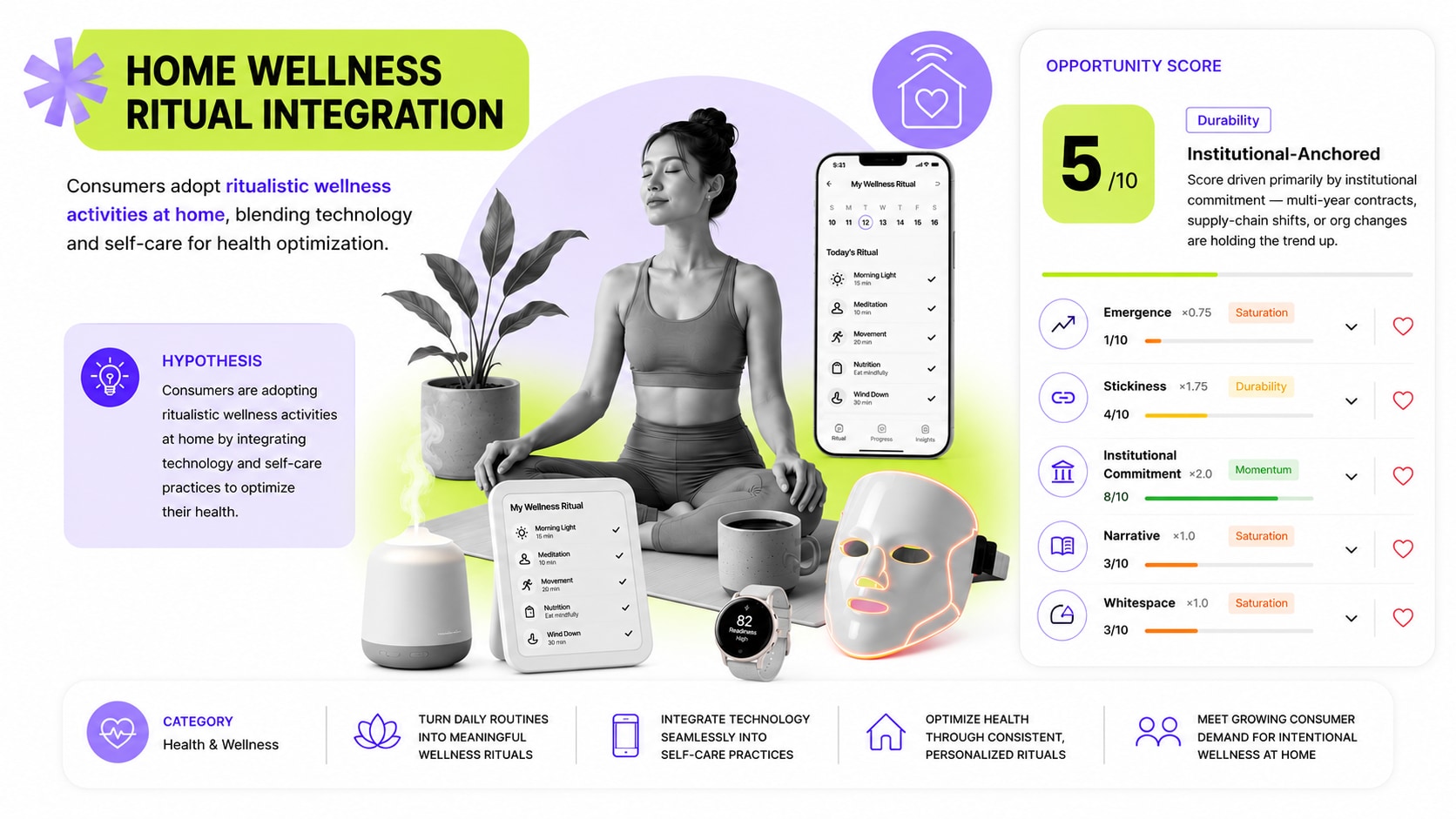
One particularly notable whitespace opportunity identified within Trend Hunter's Trend Intelligence Engine is Home Wellness Ritual Integration, which highlights how consumers are embedding repeatable wellness practices into their daily lives through connected devices, guided routines, and self-care technologies.
Trend Hunter
While still an emerging space, the opportunity is supported by strong institutional investment, reinforcing the broader shift toward wellness as emotional infrastructure, providing stability, predictability, and a greater sense of control amid ongoing uncertainty.
The housing reality, reimagined
Rising housing costs have become a powerful symbol of institutional instability, driving consumers to redefine what "home" means. As homeownership feels increasingly unattainable, consumers are shifting away from ideals of permanence toward emotional comfort, flexibility and community-driven belonging.
Notable Trend Hunter case studies include the Ellen Browning Building by Hacker Architects, a Portland-based senior co-living concept, and Brooklyn's Sigri Indian BBQ, which fuses fast-casual dining with culturally rooted comfort food. In addition, HelloFresh Supper Club reflects the growing importance of communal dining as a substitute for traditional domestic gathering, while Clayton Home Building Group's affordable manufactured housing demonstrates rising demand for financially attainable pathways to stability.
Underlying these behaviors is a growing desire for belonging. As traditional ownership milestones become harder to reach, consumers are turning toward community, ritual and emotionally grounding shared experiences as alternative forms of belonging.
Shutterstock / Collagery
Global entertainment is rewriting aspiration
Younger consumers are engaging with globally networked fandom ecosystems shaped by K-pop, Korean reality television, Asian beauty culture and digitally native music fandoms, moving away from singular American cultural dominance.
The explosive success of Netflix's KPop Demon Hunters and the upcoming U.S. expansion of Physical: 100 demonstrate how non-Western formats increasingly shape mainstream American culture. Moreover, the breakout success of Canadian-produced Heated Rivalry shows audiences embracing emotionally driven storytelling originating outside Hollywood.
Music culture is undergoing a similar transformation, with BLACKPINK and its members' continued global influence and the resurgence of BIGBANG through the viral "BANGCHELLA" Coachella reunion moment. K-pop fandom economics now rival traditional Western celebrity ecosystems, functioning as identity systems built around belonging, emotional participation and collective ritual.
This openness extends into beauty and self-optimization, with emerging behaviors like TikTok's "Chinamaxxing" obsession showing consumers borrowing identity cues and aspirational frameworks from globally distributed digital cultures.
Shutterstock / Roman Samborskyi
From institutional trust to personal regulation
As confidence in traditional systems declines, emotional infrastructure—the rituals, communities, habits and environments people use to create stability—becomes increasingly valuable, with several behavioral patterns emerging:
- Wellness as regulation: Consumers approach wellness as emotional maintenance, not luxury self-care, with rest, mindfulness and routine becoming essential tools for managing stress.
- Food as ritual: Globally inspired flavors and culturally rooted dining serve as emotional infrastructure, creating comfort and small moments of escapism.
- Fandom as belonging: Global fandoms, creator communities and shared cultural obsessions are becoming powerful sources of identity and connection, offering consumers a sense of belonging, participation and collective ritual that traditional institutions once provided.
- Community as stability: Consumers are shifting toward smaller, high-trust communities centered on emotional safety and shared values rather than mass visibility.
The end of the traditional timeline
Trend Hunter's survey by Survey Fast shows younger Americans increasingly reject the traditional path of school, career, homeownership and long-term employment as the definitive model for success, with many reporting uncertainty about what success is even supposed to look like. While the American Dream once served as a universal cultural roadmap, consumers today are building hybrid, modular identities shaped by global culture, digital communities, creator ecosystems, wellness philosophies and fandoms. Aspiration is no longer nationally standardized, but individually curated.
Strategic takeaway
American Dream Fatigue signals a major shift in how consumers define value, aspiration and emotional fulfillment. Brands that continue promoting outdated narratives centered on hustle culture, ownership milestones and traditional achievement risk feeling disconnected from consumer reality.
Future-facing brands should:
- Design repeatable rituals instead of one-time experiences
- Build emotional utility, not just functional utility
- Prioritize participation and belonging over scale alone
- Create products that fit into daily regulation systems
- Support identity-building rather than status signaling
- Design for presence, calm and emotional sustainability
The American Dream isn't disappearing. It's being redefined around emotional resilience, flexibility, community and intentional living. For innovators, the key question becomes: How is your brand helping consumers build emotional stability, belonging and everyday meaning in an era where traditional definitions of success no longer feel guaranteed?
Interested in Survey Fast? Quickly validate your ideas, products or messaging with real consumer feedback. Learn more here and launch your custom survey today.
Sources & References
- Survey Fast — American Dream
- TechRadar — Netflix Is Officially Eyeing a KPop Demon Hunters Sequel
- Netflix Tudum — Physical: 100 USA — Season 1 Release Date News
- The Hollywood Reporter — Heated Rivalry Ratings: 9 Million Viewers on HBO Max
- Us Weekly — BIGBANG 20 Years Later: Inside Their 2026 Comeback as a Trio
- Billboard — Billboard K-Pop Fandom in the U.S. Report
- The Business of Fashion — America's Obsession With Chinese Medicine Is Taking Over TikTok