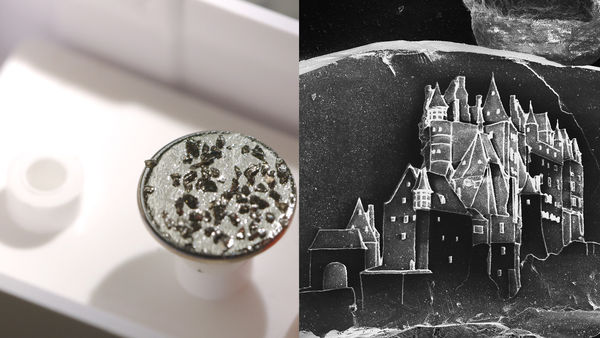
It's easy to make a sand castle with sand but not many people can make carved sand castles on a single grain. Artist Vik Muniz and Researcher Marcelo Coelho managed to etch a castle on a granule of sand. The process took four years.
The tiny drawings are half a millimeter in length and are not visible to the human eye. Muniz created sketches of the castles using a camera lucida, an optical superimposition device to turn the image into a projection on a piece of paper. This allowed him to easily trace the minuscule castles. Coelho used a focused ion beam to make the castles on a microscopic scale.
These tiny castles are making a big statement on display at the Tel Aviv Museum of Art.
What's Driving This Trend
- Microscopic Art
- Creating intricate artwork on a microscopic scale opens up new possibilities for artistic expression and creativity.
- Nano-scale Sculpting
- The use of focused ion beams to sculpt objects at the nano-scale presents opportunities for innovation in various industries, such as manufacturing and healthcare.
- Optical Superimposition
- Utilizing optical superimposition devices like camera lucida can revolutionize the way artists transfer images onto surfaces, leading to new techniques and styles.
Who This Affects Most
- Art and Design
- The field of art and design can embrace microscopic art as a new form of expression, incorporating it into galleries, exhibitions, and commercial products.
- Manufacturing
- The application of nano-scale sculpting techniques can revolutionize manufacturing processes, allowing for the production of incredibly precise and intricate components.
- Healthcare
- Nano-scale sculpting technology can be applied in the healthcare industry for developing tiny medical devices, drug delivery systems, and biosensors with high precision and efficiency.