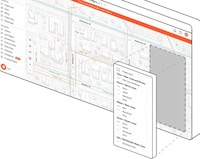
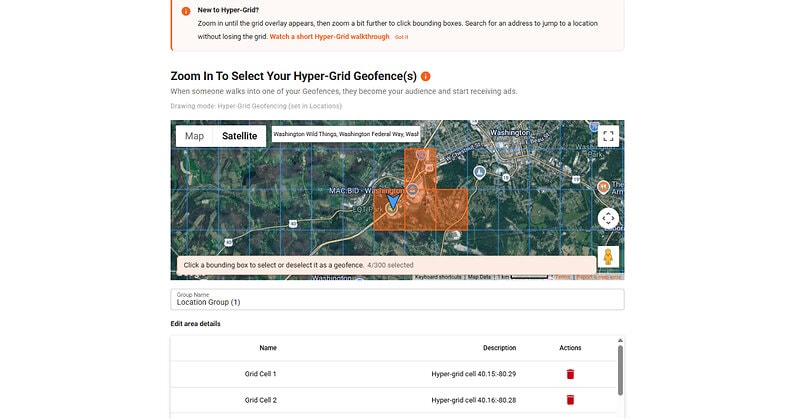
Qujam is expanding location targeting with 'Hyper-Grid' geofencing, a format built to meet privacy standards across the United States and Canada. Rather than tracing exact shapes around a location, it lets advertisers buy broader areas while still seeing the target on a map. The feature is part of Qujam's ad platform, which also refreshed its dashboard and campaign setup screens.
Each selectable square covers 0.5 miles by 0.5 miles. The grid aligns with latitude and longitude, rounded to 2 decimal places, so buyers can select visible boxes rather than having a system quietly reshape a boundary. Qujam also lets them add audience filters, including political affiliation, to narrow a campaign within those larger zones.
For marketers, this means location buying can continue to move in stricter markets without dropping the map entirely. Lower base CPMs can also increase impression volume when a campaign skips additional audience filters.
Image Credit: Qujam
What Makes This Trend Stand Out
- Privacy-safe Location Targeting
- Broader geofence formats create room for ad platforms that preserve local relevance while reducing reliance on precise consumer movement data.
- Grid-based Media Buying
- Standardized map squares introduce new planning models where advertisers trade boundary precision for transparency, scalability, and easier campaign setup.
- Regulated Audience Segmentation
- Stricter privacy environments are accelerating demand for targeting systems that blend compliant geography with optional demographic or political filters.
Sectors Adopting This
- Digital Advertising
- Location-based ad networks can differentiate through privacy-conscious targeting tools that maintain campaign performance in restrictive regulatory markets.
- Marketing Technology
- Dashboard and workflow upgrades around simplified geospatial buying highlight opportunities for platforms that make complex compliance requirements easier to manage.
- Political Campaigning
- Campaign media teams gain new ways to reach regional voter groups through broader geographic zones layered with affiliation-based audience criteria.