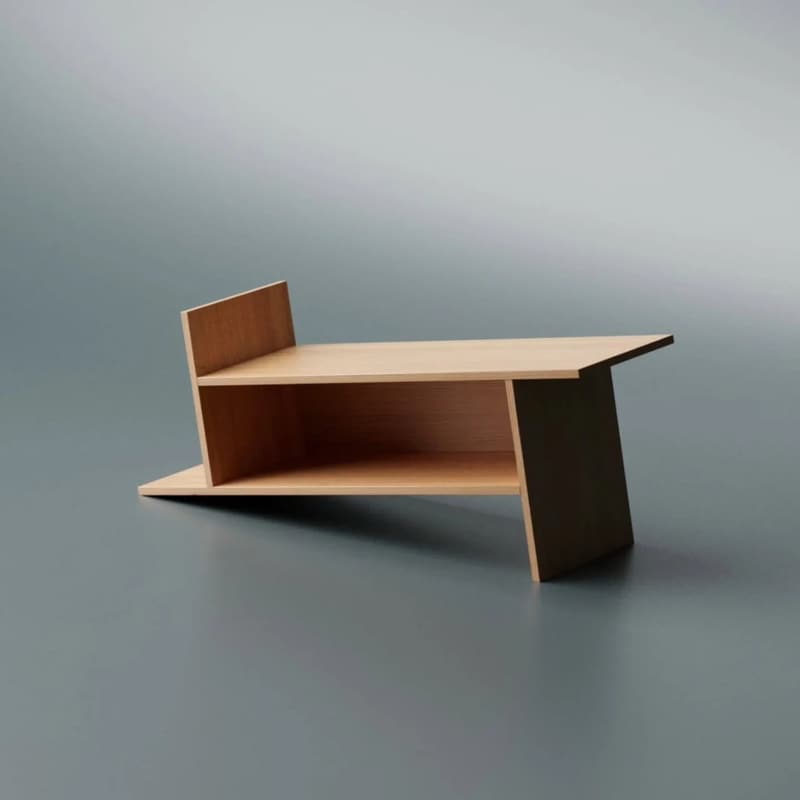
The Barrow bookrack by Deniz Aktay is a freestanding storage piece developed from a simple geometric operation that extends the lines of a rectangle into three dimensions. The design was created by German designer Deniz Aktay and translates a flat graphic concept into a functional wooden object. The structure appears tilted and asymmetrical, with extended edges forming multiple surfaces for storing books and objects.
The frame uses angled supports and projecting ledges that create distinct storage zones across the piece. Books can be placed upright within the central cavity or stacked along the outer extensions, with each surface offering a different orientation. The structure maintains balance despite its offset form, using controlled geometry rather than symmetry to stabilize the design. The bookrack is constructed from wood with a minimal material palette that emphasizes the geometry of the form.
Image Credit: Deniz Aktay
Why This Trend Is Growing
- Three-dimensional Graphic Translation
- Designs that convert flat graphic motifs into volumetric objects enable novel spatial experiences and reframe two-dimensional branding or pattern language as functional form.
- Asymmetrical Functional Sculptures
- The embrace of controlled imbalance fosters pieces that read as art while delivering practical utility, challenging norms of symmetry in product aesthetics.
- Multi-plane Storage Systems
- Layered and projecting surfaces create diverse orientations for items, opening possibilities for reconfigurable organization and differentiated display within a single unit.
Industries Being Reshaped
- Furniture Design
- A shift toward geometry-driven pieces encourages exploration of hybridized furniture that blends sculptural form with multi-function storage solutions.
- Interior Architecture
- Integrating asymmetrical, projection-based elements alters spatial planning and offers opportunities for built-in features that redefine circulation and visual focus.
- Manufacturing and Materials
- Demand for precise angled joins and minimal palettes highlights opportunities for advanced joinery, CNC woodworking, and engineered sustainable materials tailored to complex geometries.