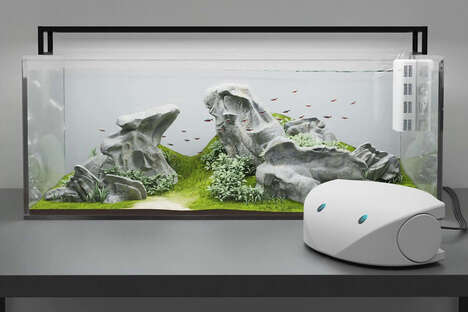

This miniature aquatic robot can change the way real fish behave. Developed by researchers from the Robotic Systems Laboratory (LSRO) at the Ecole Polytechnique Federale de Lausanne, the robot fish demonstrates how complex robots are becoming.
The team led by Professor Francesco Mondada developed the robotic zebrafish to integrate with a school of actual fish and influence their behavior. They identified zebrafish characteristics to make the aquatic robot as realistic as possible, including acceleration speed, color and shape. The seven-centimeter robot can move through water without any engine noise giving it away, as it is equipped with magnets that are connected to a small engine located beneath the aquarium. The zebrafish robot can also change its behavior to communicate and move with real fish.
What's Driving This Trend
- Mini Aquatic Robots
- The development of miniature aquatic robots holds disruptive innovation opportunities in fields such as marine exploration and environmental monitoring.
- Integration of Robots with Living Organisms
- The integration of robots with living organisms opens up possibilities for disruptive innovation in areas such as animal behavior research and bio-inspired robotics.
- Realistic Biomimetic Design
- Advancements in creating realistic biomimetic designs for robots present disruptive innovation opportunities in industries like robotics, entertainment, and education.
Who This Affects Most
- Marine Exploration
- The use of mini aquatic robots in marine exploration can revolutionize the way we study and understand marine ecosystems.
- Animal Behavior Research
- The integration of robots with living organisms, as demonstrated by the robotic zebrafish, could offer new avenues for studying animal behavior in a controlled environment.
- Robotics
- The development of realistic and behavior-changing robots like the zebrafish robot can have significant implications for the robotics industry, particularly in terms of creating lifelike robot companions and assistants.