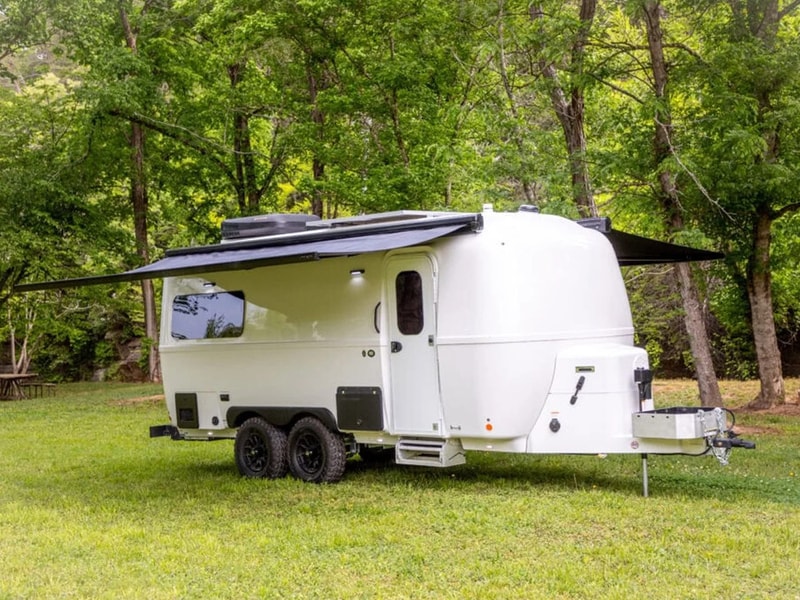
Oliver Apex X23 is a 23-foot travel trailer by Oliver Travel Trailers built around off-grid capability and all-season use. The model uses the company’s dual-hull fiberglass construction, with insulation placed between separate inner and outer shells to create an airtight body for year-round stability. Its zero-wood construction is designed to resist mold and corrosion, while molded cabinetry is integrated directly into the fiberglass interior. The layout includes a lounge, sleeping area, kitchen, and bathroom within the compact body.
The trailer offers twin beds or a king bed, plus a quilted leather dinette that converts into an additional sleeping area. The kitchen includes an induction cooktop, refrigerator, and microwave with air fryer. Power comes from a 48V system with a 3,000W inverter, central touchscreen controls, and available solar capacity up to 1,360W.
Image Credit: Oliver Travel Trailers
Key Themes Behind This Trend
- Dual-hull Fiberglass Construction
- Airtight dual-hull fiberglass designs that separate inner and outer shells create opportunities for lightweight, highly insulated structures suitable for extreme climates.
- Integrated Off-grid Power Systems
- The proliferation of 48V architectures paired with high-capacity inverters and up to 1,360W of vehicle-mounted solar points to compact, self-contained energy ecosystems for mobile living.
- Zero-wood Mold-resistant Interiors
- Eliminating wood in favor of molded fiberglass cabinetry and interior components reduces moisture-related degradation and supports longer-lasting, low-maintenance interiors.
Where This Applies
- Recreational Vehicle Manufacturing
- Recreational vehicle manufacturing is positioned to deliver premium, all-season campers that emphasize durability, thermal performance, and integrated systems for off-grid lifestyles.
- Renewable Energy Components
- Renewable energy component suppliers are seeing growing demand for scalable, vehicle-oriented solar arrays, battery packs, and 48V power electronics optimized for compact mobile platforms.
- Marine and Aerospace Composites
- Marine and aerospace composites sectors are aligned with trends toward dual-hull, corrosion-resistant fiberglass structures that prioritize strength-to-weight ratios and environmental resilience.