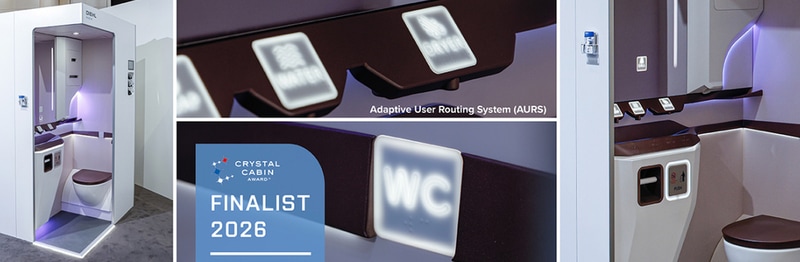
At the Aircraft Interiors Expo 2026, Diehl Aviation showcased its integrated cabin solutions portfolio, which places a focus on accessibility. A key innovation by the brand included the Space³ lavatory equipped with the Adaptive User Routing System (AURS), which was demonstrated live at the industry event.
AURS is a technology that provides coordinated visual and audio guidance to support passengers with visual or auditory impairments in navigating and operating the lavatory more independently. Diehl Aviation's AURS-equipped Space³ lavatory represents a shift from treating accessibility as an add-on to embedding it as a required standard in cabin design.
To signal the necessary push to redefine in-cabin accessibility, Diehl Aviation's innovation was recognized as a finalist for the Crystal Cabin Award 2026 in the Accessibility category at the Aircraft Interiors Expo 2026.
Image Credit: Diehl Aviation
Key Themes Behind This Trend
- Accessibility-first Cabin Design
- Designing cabins with accessibility embedded from the outset creates opportunities for rethinking space allocation, regulatory compliance, and universal-use fixtures that replace retrofit solutions.
- Adaptive User Routing Systems
- Real-time coordinated visual and audio guidance systems introduce possibilities for integrated navigation services that tailor interface modalities to individual sensory needs.
- Embedded Multimodal Guidance
- Combining audio, visual and haptic cues within cabin elements enables the development of interoperable assistive ecosystems that extend beyond single components like lavatories.
Where This Applies
- Commercial Aviation
- Airlines and OEMs face a shift toward offering differentiated passenger experiences that prioritize inclusive design as a competitive and regulatory vector.
- Aerospace Interior Manufacturing
- Interior suppliers are positioned to innovate modular, certification-friendly products that integrate sensing, guidance and accessible hardware into standard cabin suites.
- Assistive Technology for Travel
- Companies in assistive tech can leverage in-cabin sensing and adaptive interfaces to create travel-specific accessibility platforms that bridge aircraft systems and passenger devices.