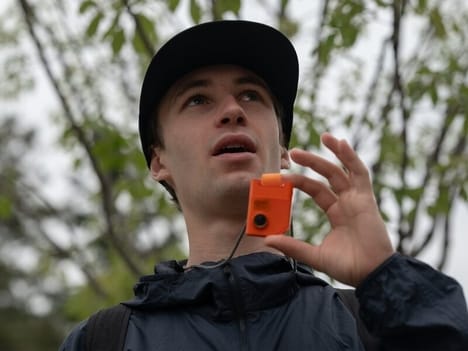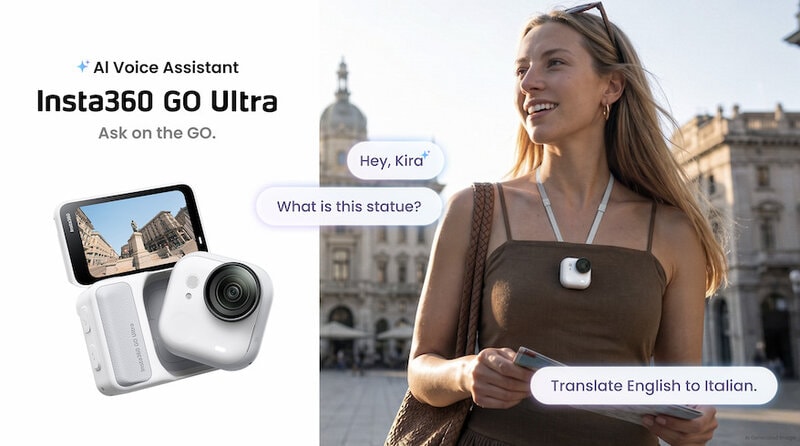
Insta360 has introduced an AI Voice Assistant for its GO Ultra wearable camera. This software update is built with Google Gemini and transforms the palm-sized device from a simple first-person vlogging tool into an interactive travel companion capable of real-time translation, voice-based queries, and photo-driven question answering. All of these capabilities are accessible hands-free by long-pressing the shutter button or saying 'Hey, Kira.'
Insta360's AI Voice Assistant update enables four primary functions — spoken conversation interpretation that allows users to communicate across language barriers without passing a phone back and forth, photo recognition that can identify signs, buildings, and landmarks by simply pointing the camera, voice-activated inquiries about practical information such as weather, prices, or local history, and voiceprint technology that isolates the user's voice amidst ambient noise to ensure accurate responses in crowded environments.
Image Credit: Insta360
Key Themes Behind This Trend
- AI Travel Companions
- Wearable devices are evolving into context-aware guides that blend translation, local discovery, and real-time assistance for more seamless travel experiences.
- Hands-free Visual Search
- Camera-based AI recognition is creating new value in everyday exploration by letting users identify landmarks, signs, products, and surroundings without relying on smartphones.
- Voiceprint Wearables
- Personalized voice isolation in compact devices is improving AI reliability in noisy public spaces, expanding use cases for commuting, tourism, events, and fieldwork.
Where This Applies
- Consumer Electronics
- AI-enabled hardware updates are extending the utility of compact cameras and wearables, creating premium differentiation beyond image capture.
- Travel and Tourism
- Real-time translation and location-aware answers are reshaping visitor services by embedding concierge-like intelligence directly into personal devices.
- Artificial Intelligence
- Multimodal AI integration across voice, image, and environmental context is opening new commercial pathways for assistants that operate outside traditional phone or desktop interfaces.