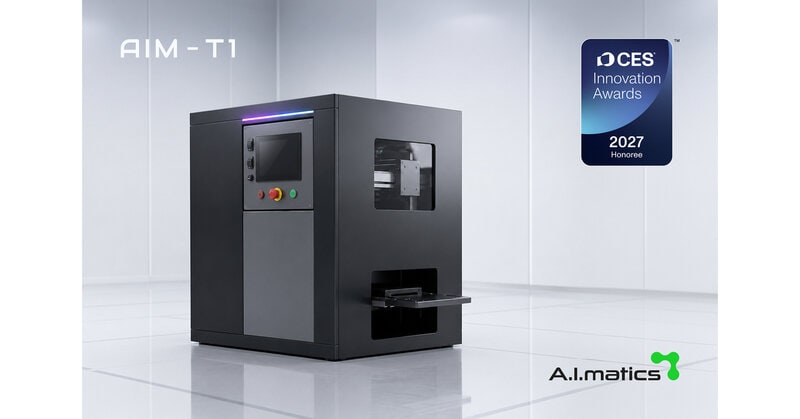
A.I.Matics is bringing adaptive inspection systems to electronics production with ‘AIM-T1,’ an AI vision inspection platform built to help teams handle frequent product changeovers. It pairs modular imaging hardware with software-defined inspection so engineers can reuse inspection workflows instead of rebuilding them each time a new product enters the line.
The platform uses reference samples to set acceptable product criteria and spot deviations that can indicate defects. It also combines world model technology with in-context learning, while liquid lens optics and electronic focus stacking capture multiple focal planes without mechanical Z-axis movement.
A.I.Matics shows how CES 2027 honoree status can give AIM-T1 a strong showcase for factories that need inspection methods to travel with production, while reducing the dependence on product-by-product expertise makes it easier to set up new lines and new sites without starting from scratch.
Image Credit: A.I.Matics
What Makes This Trend Stand Out
- Software-defined Inspection
- Flexible vision workflows create room for manufacturers to shift quality control from fixed tooling to reusable inspection logic across fast-changing product lines.
- In-context Industrial AI
- Reference-based learning enables inspection platforms to adapt to new products with less manual rule-building, opening possibilities for faster line qualification and broader factory deployment.
- Focus-stacked Machine Vision
- Liquid lens optics and multi-plane imaging support richer defect detection without mechanical motion, expanding the role of compact vision systems in precision electronics manufacturing.
Sectors Adopting This
- Electronics Manufacturing
- High-mix production environments gain new potential from adaptive inspection platforms that reduce changeover friction and standardize quality methods across product variants.
- Industrial Automation
- Modular imaging hardware combined with AI software signals a shift toward configurable automation systems that can scale across sites without extensive custom engineering.
- Quality Assurance Technology
- AI-enabled defect detection broadens the market for inspection tools that embed expert criteria into repeatable workflows, reducing reliance on specialized product-by-product knowledge.