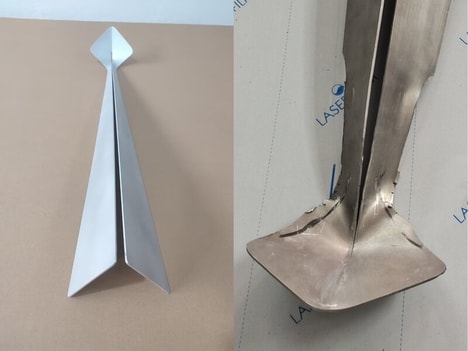
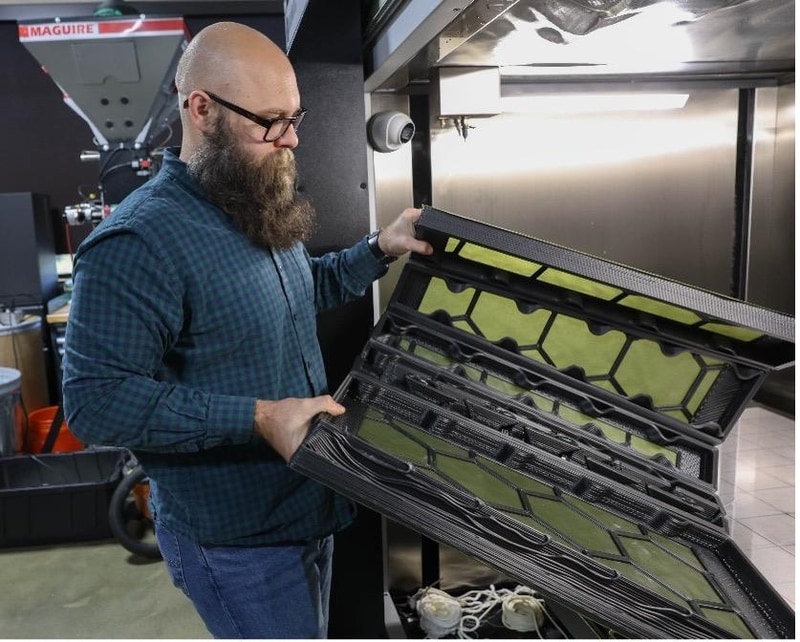
Mold-free composite manufacturing is advancing lightweight production by combining origami-inspired design with hybrid composite 3D printing to eliminate traditional molds. Developed by researchers at Oak Ridge National Laboratory (ORNL), the process deposits composite materials directly onto flexible fabric substrates, creating flat structures that can be folded into three-dimensional forms while reducing fabrication time and costs. The method also enables manufacturers to produce components larger than the printing system itself, expanding design possibilities for industries requiring large, lightweight structures.
For manufacturers, this development could lower tooling expenses, accelerate product development, and make customized composite production more economically viable. The ability to produce complex geometries without dedicated molds supports faster iteration and reduces storage and maintenance requirements associated with conventional tooling. Applications across aerospace, automotive, construction, and defense could benefit from more flexible production workflows, allowing companies to respond more quickly to changing design requirements while improving manufacturing efficiency and scalability.
Image Credit: Amy Smotherman Burgess/ORNL, U.S. Dept. of Energy
Why This Trend Is Growing
- Mold-free Composites
- Tooling-free fabrication creates opportunities for lower-cost lightweight parts, faster design cycles, and more adaptable composite production across large-format applications.
- Origami-inspired Manufacturing
- Foldable flat-to-3D structures introduce new possibilities for producing complex geometries that exceed printer size limitations while simplifying assembly workflows.
- Hybrid Composite Printing
- Direct deposition onto flexible substrates expands the role of additive manufacturing in scalable, customized component production with reduced material and tooling constraints.
Industries Being Reshaped
- Aerospace
- Large, lightweight composite structures can support more efficient aircraft component development where weight reduction, customization, and rapid iteration are increasingly valuable.
- Automotive
- Flexible composite production methods provide new pathways for lighter vehicle parts, shortened prototyping timelines, and economical small-batch manufacturing.
- Construction
- Foldable composite fabrication offers potential for transportable, large-scale building elements that reduce production complexity and enable novel structural designs.