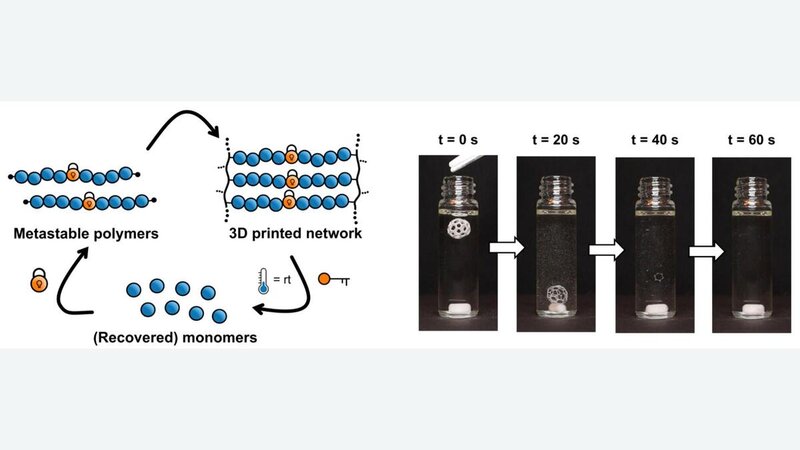
Closed-loop 3D printing polymers could make high-precision additive manufacturing more sustainable through materials designed for complete chemical reuse. Researchers at Heidelberg University developed a light-based printing material that remains mechanically stable during use but can be disassembled into its molecular building blocks within seconds at room temperature. A specific chemical trigger activates a predetermined breaking point in the polymer chain, allowing the components to be recovered and converted back into polymer with the same molecular composition and material properties.
For manufacturers, this approach could reduce waste associated with thermoset materials that are typically difficult to recycle after printing. Recovering and reusing the same molecular components may also reduce demand for virgin materials while supporting more circular production systems. The technology could be particularly relevant for industries using high-resolution 3D printing, including personalized medicine and soft robotics, where complex components require precise material performance.
Image Credit: The Blasco group
Key Themes Behind This Trend
- Closed-loop Additive Materials
- Reusable polymer systems are creating new pathways for high-precision manufacturing with reduced material waste and lower dependence on virgin feedstocks.
- Triggerable Polymer Breakdown
- Chemically activated disassembly enables printed components to retain durability in use while rapidly reverting into recoverable molecular building blocks.
- Circular Thermoset Printing
- High-performance thermoset-like materials are becoming more compatible with circular production models through complete chemical recyclability.
Where This Applies
- Additive Manufacturing
- Precision 3D printing platforms can gain sustainable material cycles that preserve performance while minimizing discarded production inputs.
- Personalized Medicine
- Custom medical devices and microstructures benefit from reusable printing materials that support complex geometries without sacrificing biocompatible precision.
- Soft Robotics
- Flexible robotic components requiring tailored mechanical properties are aligned with recyclable polymer systems that maintain function across specialized applications.