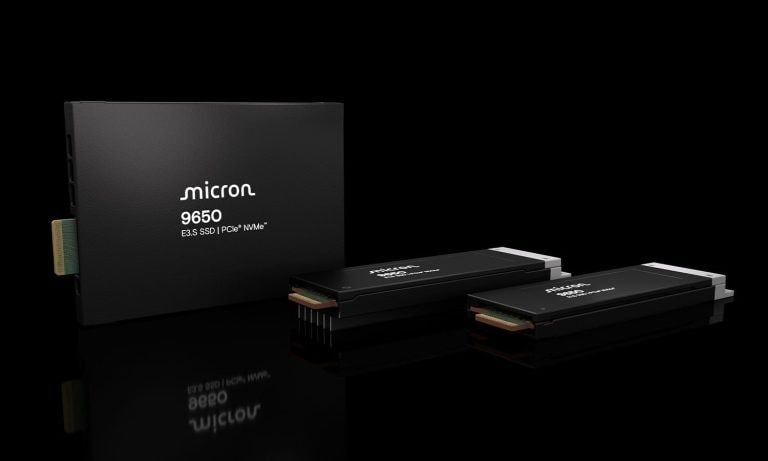
The Micron 9650 NVMe SSD is the first commercially available PCIe Gen6 data center storage solution, officially launched in July 2025. It delivers up to 28 GB/s of sequential read bandwidth and 5.5 million IOPS for random reads, positioning it as the fastest data center SSD on the market. Built on Micron’s vertically integrated architecture, the 9650 incorporates Micron G9 TLC NAND and is offered in both E1.S and E3.S form factors, with options for air-cooled heatsinks or liquid-cooling integration to support high-density, thermally demanding AI and enterprise workloads.
Available in Pro and Max variants, the 9650 spans capacities from 6.4 TB to 30.72 TB and features peak sequential write speeds of 14 GB/s. The Pro model is tuned for read-intensive applications with one drive write per day (DWPD) endurance, while the Max version supports mixed-use workloads at three DWPD and delivers up to 900 kIOPS for random writes compared to 570 kIOPS on the Pro. Energy efficiency improvements over previous-generation drives help data centers reduce power consumption and carbon emissions, aligning performance gains with sustainability objectives.
Image Credit: Micron
What Makes This Trend Stand Out
- Sustainable Data Center Solutions
- The integration of energy-efficient SSDs aligns with the growing demand for sustainable technology in data centers, reducing power consumption and carbon footprints.
- High-density Storage Innovation
- The development of SSDs with capacities up to 30.72 TB presents opportunities for innovation in high-density storage solutions, addressing the needs of data-intensive industries.
- Liquid-cooled Storage Advances
- The option for liquid-cooling integration in SSDs enhances thermal management in data centers, a critical aspect for supporting high-performance and thermally demanding workloads.
Sectors Adopting This
- Data Storage Technology
- The introduction of sixth-generation, high-speed SSDs marks a significant advancement in data storage technology, catering to the accelerating demands of enterprise and AI workloads.
- Green IT Solutions
- Efforts in improving SSD energy efficiency are driving the green IT movement, as businesses look to decrease environmental impacts while maintaining performance.
- Cooling Systems Design
- Innovative cooling solutions, such as the adoption of liquid-cooling in SSDs, are reshaping cooling system designs to better handle the heat generated by advanced data processing devices.